
1-805-484-2992
Quotes - Engineering - SalesTwo grades cover ninety percent of sanitary work
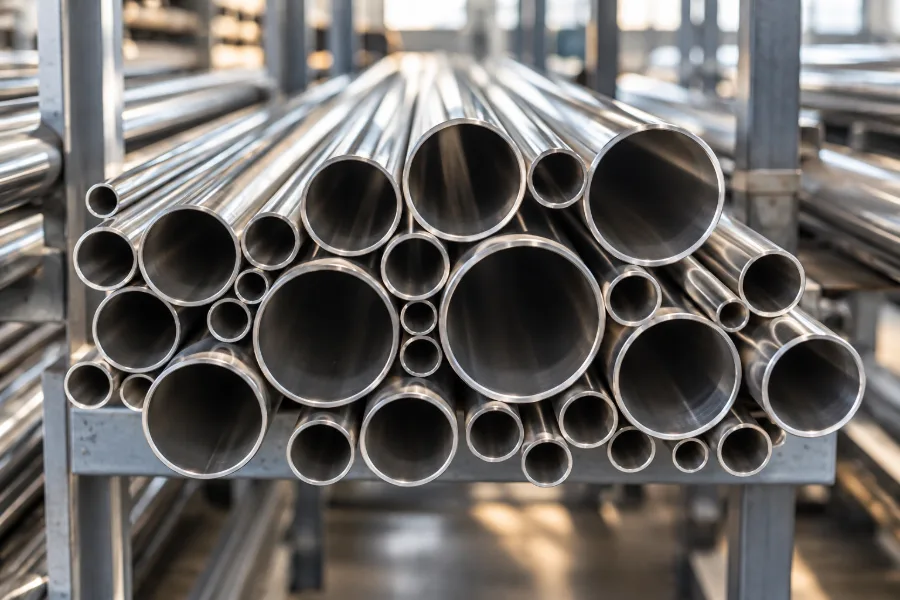
304L and 316L are both austenitic stainless steels with about 18 percent chromium. 316L adds 2 to 3 percent molybdenum and a little more nickel, and that molybdenum is the whole difference in service: it raises resistance to pitting and crevice corrosion in the presence of chlorides. Everything else, from polishability to weldability to strength, is close enough that the two are interchangeable in fabrication.
So the choice comes down to one question: will the product-contact surface see chlorides, hot, at any point in the product or the cleaning cycle? If not, 304L. If so, 316L. If the chlorides are high and hot, brine chillers and some concentrates, neither is enough and the duplex and superaustenitic grades take over. Pharmaceutical water is 316L by specification regardless.
304L
- 18 Cr, 8 Ni, PREN about 19
- Milk, whey, juice, wort, syrup and steam
- Pits under a hypochlorite rinse within years
316L
- 2 to 3 Mo added, PREN about 24
- Brine, concentrates, salted sauces, hot WFI
- Tolerates roughly twice the chloride
Stainless grades for product contact
Composition and resistance
- 304L: 18 Cr, 8 Ni, 0.03 C max; PREN about 19
- 316L: 16 to 18 Cr, 10 to 14 Ni, 2 to 3 Mo; PREN about 24
- 2205 duplex: 22 Cr, 5 Ni, 3 Mo, 0.15 N; PREN about 35
- AL-6XN: 20 Cr, 24 Ni, 6 Mo, 0.2 N; PREN about 45
- Hastelloy C-22: 22 Cr, 13 Mo, 3 W, nickel base; PREN over 65
Tube specifications
- ASTM A270: Sanitary tubing, welded or seamless, polished ID and OD, 304L or 316L
- ASTM A269: Seamless and welded tubing for general service; pressure tube in bundles
- ASTM A249: Welded boiler and heat exchanger tube; the industrial bundle standard
- Sulfur-controlled 316L: 0.005 to 0.017 percent S for consistent orbital weld penetration (BPE)
- Common sizes: 0.75 and 1 inch OD, 0.065 wall; 1.5 inch and up for tube-in-tube
Chlorides pick the grade; the product rarely does
Selecting the stainless for a sanitary exchanger
Where 304L is the right answer
Milk and cream, whey, juice without added salt, wort and beer, wine, sugar syrup, edible oil, plant hot water, chilled water and steam are all mild to 304L. A standard CIP program of caustic followed by nitric or phosphoric acid does not attack it. It is the correct default for food and dairy shell-and-tube and tube-in-tube exchangers, and it is what most 3-A units are made from.
The one caveat is the sanitizer. A plant that finishes its CIP with a hypochlorite rinse is putting chloride on the hot surface every day. On 304L that produces pitting at the tube welds within a few years. Peracetic acid sanitizers avoid the problem; if hypochlorite is the plant standard, buy 316L.
Where 316L is required
Chlorides in the product make the decision: brine and pickle liquors, tomato and citrus concentrates, sauces with added salt, sports drinks with electrolytes, and any seawater-derived ingredient. So does hot purified water: WFI at 80 C and hot purified water loops rouge 304L quickly and every BPE specification calls for 316L. For orbital welding on BPE work the tube and fittings should be sulfur-controlled 316L, with sulfur held between about 0.005 and 0.017 percent, because sulfur at the low end of the ordinary range gives shallow, wandering weld penetration and mismatched sulfur between two parts steers the weld pool toward one side.
PREN, the pitting resistance equivalent number, is the shorthand: chromium plus 3.3 times molybdenum plus 16 times nitrogen. 304L at about 19 and 316L at about 24 sit close together; the practical rule is that 316L tolerates roughly twice the chloride at the same temperature before pitting begins.
- 316L for any product or CIP step with chlorides, and for all pharmaceutical water
- Sulfur-controlled 316L on orbitally welded pharma tube and fittings
- Match the sulfur range between tube and fitting heats on a BPE weld
Above 316L: duplex, superaustenitic, nickel alloys
When chlorides are high and hot together, brine chillers below 30 F running 20 percent sodium chloride, seawater cooling, hot concentrated pickle liquor, the PREN of 316L is not enough and stress corrosion cracking joins pitting as a failure mode. 2205 duplex at PREN 35 resists both, and its higher yield strength allows a thinner tube wall for the same pressure, which partly offsets its cost. AL-6XN, a superaustenitic grade with 6 percent molybdenum, handles seawater and the hottest brines and polishes and welds much like 316L. Hastelloy C-22 is a nickel-base alloy reserved for cleaning or process chemistry that mixes acids and oxidizers, as in some biotech decontamination systems; it is not a food alloy in any normal sense.
Each of these alloys is ordered for a named chemistry, never as a general upgrade.
Tube specifications and what they mean
A sanitary exchanger tube is bought to ASTM A270, the sanitary tubing standard, which calls for polished surfaces and controlled dimensions, in 304L or 316L, welded or seamless. The bundle's utility-side tube on a double-tubesheet or an industrial-utility unit may be to A269 or A249, the general and heat-exchanger tube standards, where a polished bore is not needed. The mill certificate for each heat states the standard, the grade, the chemistry and the mechanical properties, and it is the document that proves the tube is what the drawing says.
Ordering the grade
State the product-contact grade, the shell-side grade if different, the tube standard, and whether seamless or welded tube is required. Add the chloride source if there is one, so the choice can be confirmed against the actual chemistry. Call and talk it through with an engineer: 1-805-484-2992
Common FAQs
Yes. Product-contact parts in 316L with a 304L shell and utility side is a common and economical arrangement. The two weld to each other without difficulty.
316L is the low-carbon version, with 0.03 percent carbon maximum against 0.08 for 316. Sanitary tube and fittings are 316L because they are welded and the low carbon prevents sensitization at the weld. Dual-certified 316/316L material satisfies both.
Rouge is a thin iron oxide film that forms on stainless in hot purified water. 316L slows it and electropolish slows it more, but no stainless stops it entirely; pharmaceutical loops derouge on a schedule.
Sulfur changes how the orbital weld pool flows. Too little and penetration is shallow; a mismatch between the two parts and the pool shifts toward the lower-sulfur side, leaving an off-center root. Holding both parts in a narrow sulfur band gives repeatable full-penetration welds.
Related
Design & Fabrication
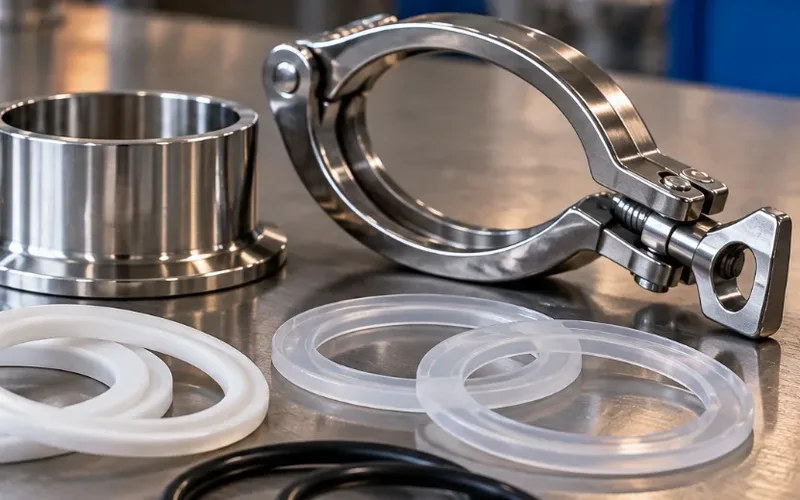
Gaskets & Elastomers
Which compound survives your CIP, your product and your steam, and how long before it needs changing.
+ Learn More
Design & Fabrication
Material Certs & Traceability
The documents that prove what was welded in, how it was finished and that it held pressure.
+ Learn More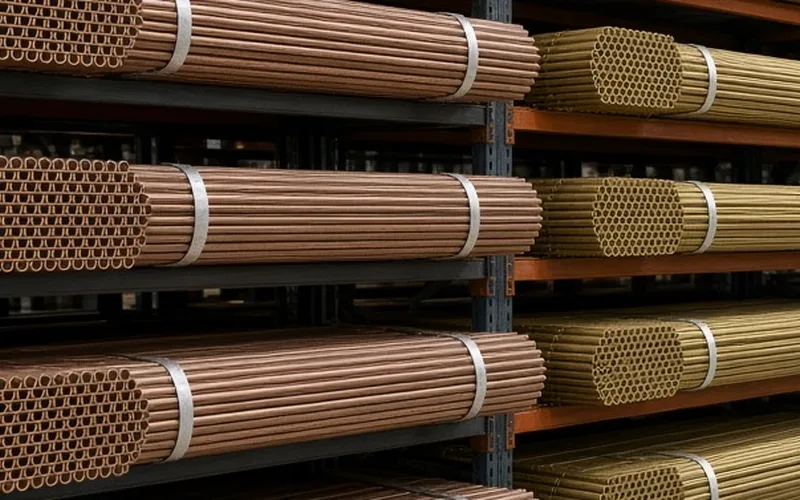
Design & Fabrication
Materials
The metal in the tubes, the rubber in the joints, and the paper that proves which heat went where.
+ Learn More