
1-805-484-2992
Quotes - Engineering - SalesPlate-exchanger performance with a second barrier
A double-wall plate is two thin plates pressed together so their corrugations nest, then welded at the ports. Between the two plates is a very thin air space that is open to atmosphere at the plate edge. If either plate develops a pinhole, the leaking fluid enters that space and drains to the outside of the pack where it can be seen; it never enters the channel on the far side. The exchanger keeps most of the compactness and approach temperature of a single-wall plate unit while removing the failure mode that keeps a QA manager awake.
The duties that ask for it are the ones where the utility side is something that must never contaminate the product: propylene glycol or brine on a juice or beer chiller, tower water on a pharma water cooler, or plant hot water on a product heater where the hot water is treated with corrosion inhibitors. Purified water and WFI heaters and coolers under ASME BPE specify double-wall plates for the same reason shell and tube units specify double tubesheets.
The trade-offs are modest: the paired plate has slightly lower heat transfer than a single plate of the same area, and the pack is a little longer for a given duty. The plate count is increased at sizing to cover it.
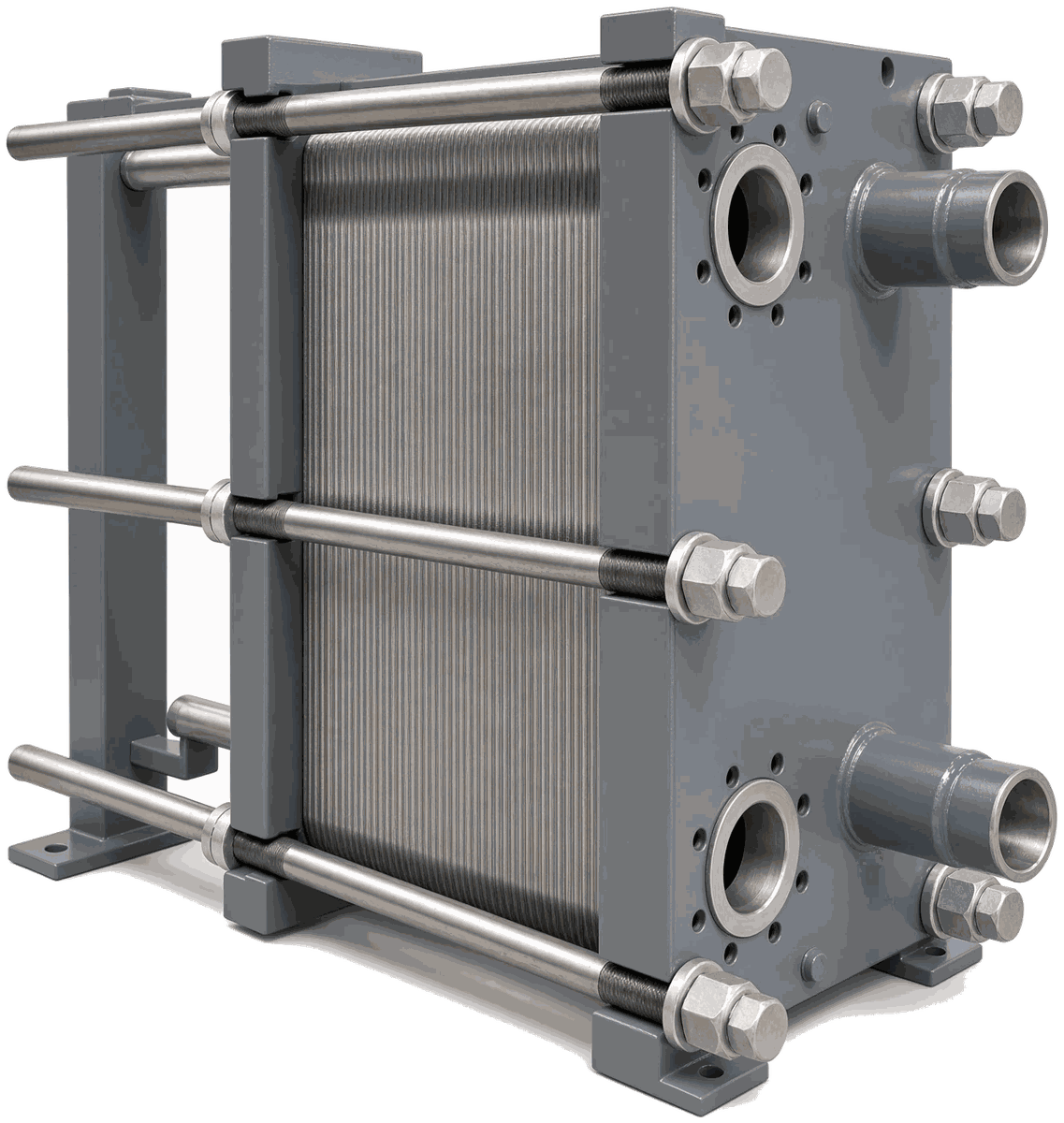
Glycol on one side, juice on the other, and a gap between them that tells you the moment anything is wrong.
Double-wall plates: the leak drains to the floor, not into the product.
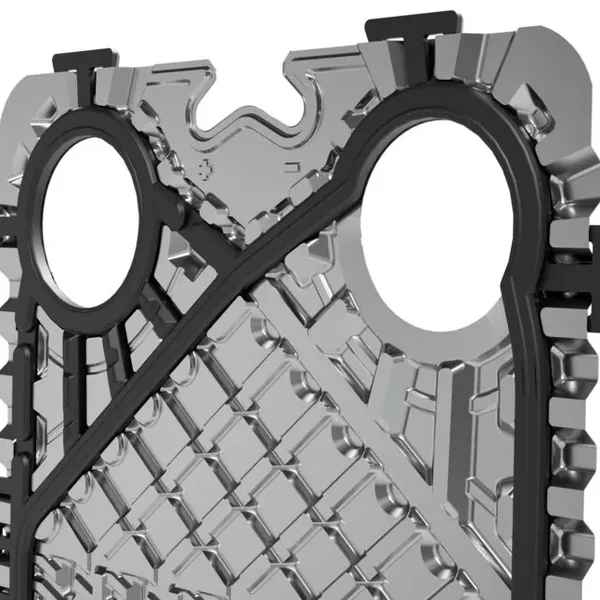
A second barrier you can see
- Leak drains out the plate edge, never across
- Drip tray with sensor logs any event
- Pinhole in either plate cannot reach the far side
- Vented air space stays open to atmosphere
- Pair welded at the ports, replaced as one assembly
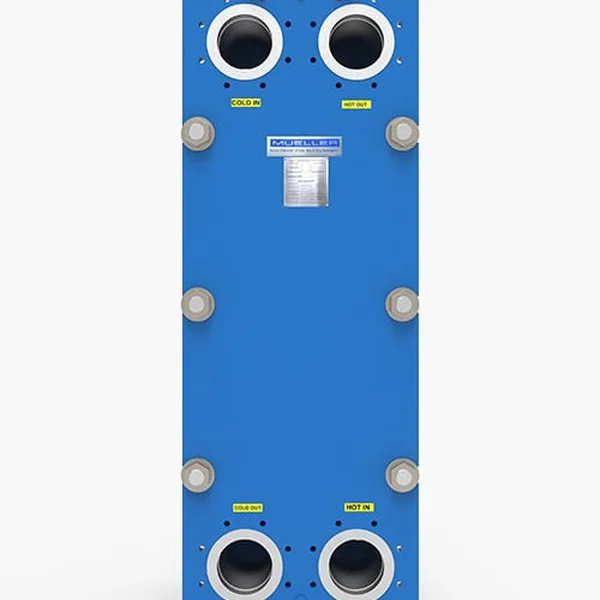
Plate compactness for sanitary duty
- Fits point-of-use cooler racks where a shell would not
- Close approach on glycol and brine chillers
- 316L plates with BPE tri-clamp ports
- Extra plates in the same frame cover the thermal penalty
- Opens for inspection like any gasketed frame
Specify It With



Double-wall plate, typical sanitary build
These rows describe the standard sanitary double-wall plate unit and where it differs from a single-wall frame. Compare them with your duty and send the fluids and cleaning method with the quote request.
| Feature | Detail |
| Plate construction | Two plates per position, corrugations nested, welded at the port necks |
| Leak path | Air gap between plates vents at the plate edge; leak visible outside the pack |
| Plate material | 316L standard for pharma and glycol duty; 304L available |
| Plate area | Roughly 1 to 30 sq ft per pair, typical range for sanitary duty |
| Thermal penalty | Generally 10 to 20 percent more area than single-wall for the same duty |
| Gaskets | EPDM standard, nitrile or FKM as product and chemistry require; food-grade |
| Ports | Tri-clamp studded 1" to 4" typical; sanitary flanges on larger frames |
| Design pressure | 150 psig typical |
| Design temperature | Generally 250 F with EPDM; hot pharma water loops at 176 F continuous |
| Codes | ASME BPE where specified, 3-A plate exchanger standard, ASME U-stamp frame, PED, CRN |
Where double-wall plates belong and how they behave
Glycol and brine chillers
Beverage, brewery and dairy plants chill product against propylene glycol at 25 to 28 F or against brine. Both are food-safe in principle and neither is welcome in product in practice, and a single-wall plate exchanger has one plate thickness between them. A double-wall plate unit keeps the glycol loop and the product loop separated by two plates and an air gap. The chiller still reaches an approach of a few degrees, still hangs on a compact frame, and still opens for inspection. Beer and wort chillers, juice coolers after pasteurization and yogurt coolers are the everyday cases.
Pharmaceutical water and product
Purified water and WFI loops are heated and cooled continuously, and the utility on the other side of the plate is plant steam condensate, hot water or tower water. ASME BPE practice treats a single wall between utility and high-purity water as a risk and calls for a double-wall design or an equivalent barrier. Double-wall plate units in 316L with electropolished plates and BPE tri-clamp ports meet that requirement in a fraction of the footprint of a double tubesheet shell and tube, and they are the common choice for point-of-use coolers where a rack-mounted plate unit fits and a shell would not.
- PW and WFI heaters and coolers
- Point-of-use coolers on hot loops
- Product heating with inhibited plant hot water
- Any duty where a risk assessment names the utility as a contaminant
Sizing for the thermal penalty
The air gap between the paired plates is a small resistance to heat flow, and the nested corrugations do not touch everywhere, so a double-wall plate delivers somewhat less duty per square foot than a single plate. The usual allowance is 10 to 20 percent more plate area, taken as additional plates in the same frame. Pressure drop per channel is unchanged because the flow channels are the same geometry. Sizing is otherwise identical to a gasketed plate unit, including the CIP velocity check.
Detection and maintenance
A leak in a double-wall plate shows as a drip at the plate edge, and plants that want a logged event fit a drip tray with a sensor under the pack. Because the paired plate is welded only at the ports, the assembly is replaced as a pair; individual plates are not separated in the field. Gasket replacement, pack opening and inspection are the same as on a standard gasketed unit. Frames are ordered with spare bar length for future plates in the usual way.
When the product must be protected from the utility and a plate exchanger is the right thermal answer, double-wall plates are how both requirements are met at once. Call and talk it through with an engineer: 1-805-484-2992
Common FAQs
Both put a vented gap between product and utility. Choose double-wall plates when the product is water-like, the approach needs to be tight, floor space is limited or regeneration is involved. Choose the double tubesheet shell and tube when steam is the utility, pressures are higher, product is viscous or contains solids, or an inspection program wants open tube bores.
Typically 10 to 20 percent more plates for the same duty, which adds a few inches of pack length. The frame footprint is otherwise the same.
Yes. The product and utility channels are the same geometry as single-wall plates and CIP runs at the same 160 to 180 F with the same chemistry. The air gap between plates is outside both circuits and is not cleaned or wetted.
Liquid appears at the outer edge of the pack from the gap between the paired plates. Because the gap is dry in service, any moisture there is a positive indication. A drip tray with a sensor turns that into an alarm.
EPDM handles propylene glycol and CIP chemistry well and is the standard choice. Nitrile is used where the product side carries fats. FKM is reserved for higher temperature or aggressive chemistry.
Yes. 316L plates with an electropolished product face and ASME BPE tri-clamp ports are the standard build for PW and WFI service, with material certifications and surface finish documentation supplied.
Related
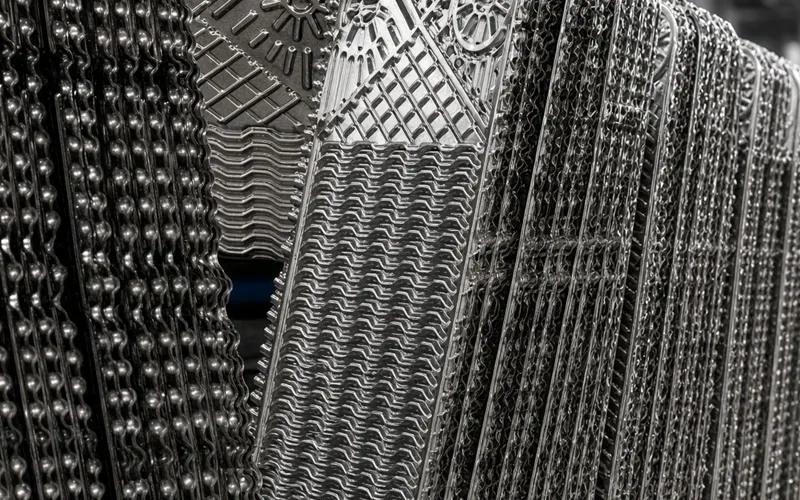
Sanitary Exchangers
Gasketed Plate
Chevron plates, food-grade gaskets and a frame you can open: the standard sanitary plate unit.
+ Learn More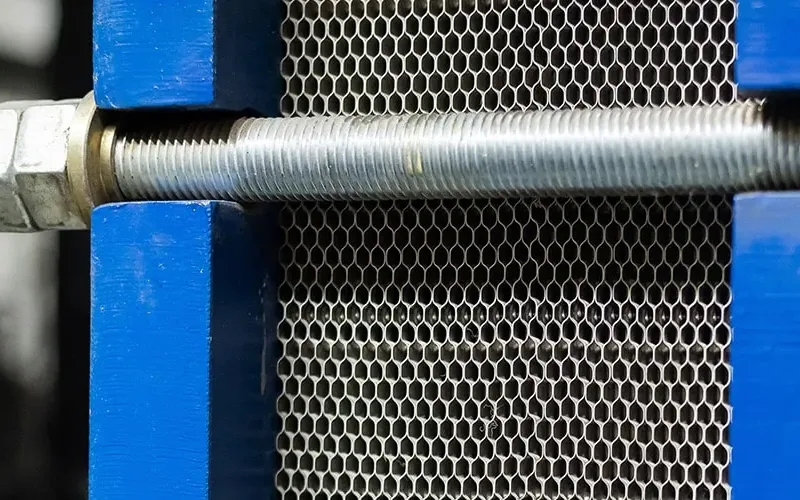
Sanitary Exchangers
Wide-Gap Plate
Plate-exchanger economics for product that would plug a standard chevron pack.
+ Learn More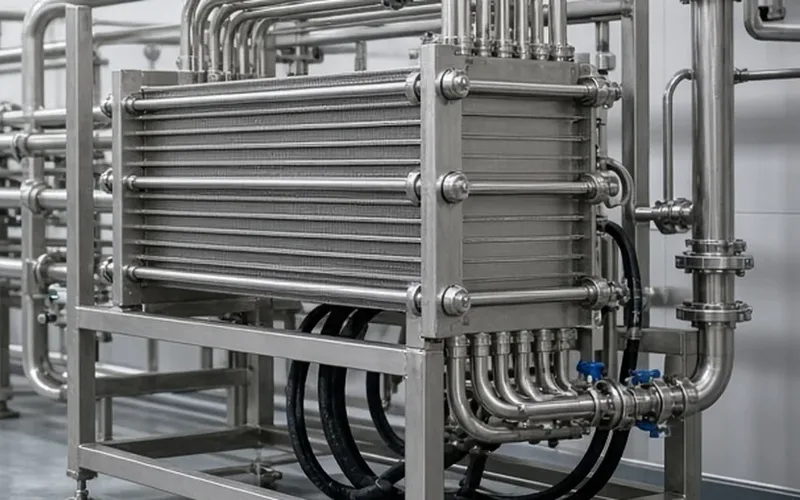
Sanitary Exchangers
Plate & Frame
Close approach, regeneration and a pack that opens for inspection: the pasteurizer's construction.
+ Learn More