
1-805-484-2992
Quotes - Engineering - SalesDairy Heat Exchangers
The legal minimum for fluid milk is 161 F held for 15 seconds, and the exchanger that does it is almost always a gasketed plate unit split into regeneration, heating and cooling sections with a holding tube and flow diversion valve between them. Regeneration is where the money is: a well-designed section recovers 85 to 95 percent of the heat, so the hot water side only has to lift the milk the last 10 to 20 degrees.
The page covers section sizing, why the holding tube length is set by the slowest particle rather than the average flow, what the pressure differential across the regenerator has to be, and how a shell-and-tube pasteurizer is arranged when plates are not the right answer.
Above 250 F the rules change. UHT runs 275 to 285 F for 2 to 5 seconds and makes a shelf-stable product; extended shelf life runs 250 to 260 F and buys 30 to 90 days under refrigeration. Both cook protein onto hot surfaces, so the heating section is usually tubular, the wall temperature is held close to the product temperature, and the run length between cleanings is a design number, not an accident.
That page explains indirect versus direct heating, why the final heater sees pressurized hot water rather than steam, how the cooler is staged, and which construction gives you the longest run before the pressure drop says it is time to clean.
Raw milk cooling, cream heating for separation and standardization, whey cooling off the vat and whey concentrate handling each have a different viscosity and a different fouling habit. Cream at 40 percent fat is several times the viscosity of skim and channels badly in a plate pack; whey carries fines that lodge in narrow gaps; raw milk arrives at 95 F and has to be below 40 F within minutes.
The page gives the film coefficients to expect, where a wide-gap plate or a tube-in-tube earns its place, and how to size a raw milk cooler on chilled water versus glycol.
Yogurt mix is heated to 185 to 195 F and held, then cooled to a culture temperature of 108 to 113 F; cheese milk is warmed to 88 to 90 F for the vat; cooked whey and curd wash water need their own exchangers. Set yogurt leaves the exchanger before it thickens, but stirred yogurt and cultured products are pumped after the break and shear is the enemy.
That page covers the low-shear tube-in-tube and wide-gap plate choices for post-culture cooling, the cheese-vat hot water loop, and the whey heater that feeds the protein recovery step.
Pasteurizers, regenerators, cream and whey coolers and cheese-milk heaters, built to 3-A, sized to your line.
Where They Run




Four questions settle most dairy exchanger selections before anyone opens a rating program. They are the same four the HeatX application engineer will ask on the phone, so having them ready shortens the quote to one conversation. Dairy is also the market where the inspector has an opinion on the exchanger itself: the holding tube, the flow diversion valve, the regenerator pressure relationship and the 3-A symbol are checked on the floor, not on the drawing, and a unit that was sized right but built without them does not get a permit to run.
Which regulation is in charge
- Grade A fluid milk under the PMO: legal time and temperature, holding tube, flow diversion, regenerator pressure differential
- Manufacturing grade for cheese and cultured product: same hardware, more latitude on the profile
- 3-A 12-07 for plate units and 3-A 12-07 or 11-02 for tubular units where the plant's inspector expects the symbol
- Export lines add PED or CRN on the pressure envelope
Product physics
- Skim and whole milk: water-like, plate-friendly, 5,000 to 8,000 lb/h per plate channel pass is typical
- Cream above 30 percent fat: viscous and shear sensitive, wider gaps or tubes
- Whey and permeate: fines, fast mineral scaling above 160 F
- Cultured product: no plates after the break, tube-in-tube with generous ID
Utility side
- Hot water set 3 to 5 degrees above the pasteurization temperature keeps wall temperature gentle
- Steam only through a hot water set or a shell-and-tube heater, never directly on a plate pack
- Chilled water at 34 to 36 F for raw milk and final cooling
- Propylene glycol at 25 to 28 F when the product must leave below 38 F
Cleaning regime
- Caustic at 160 to 180 F, 1 to 2 percent, followed by acid for milkstone
- CIP flow at 1.5 times the product flow to get velocity in the largest channel
- Gasket compound rated for the caustic and the peracetic sanitizer, EPDM on most dairy plates
- Design pressure margin for CIP pump head, which is often higher than the product pump
Related
Applications
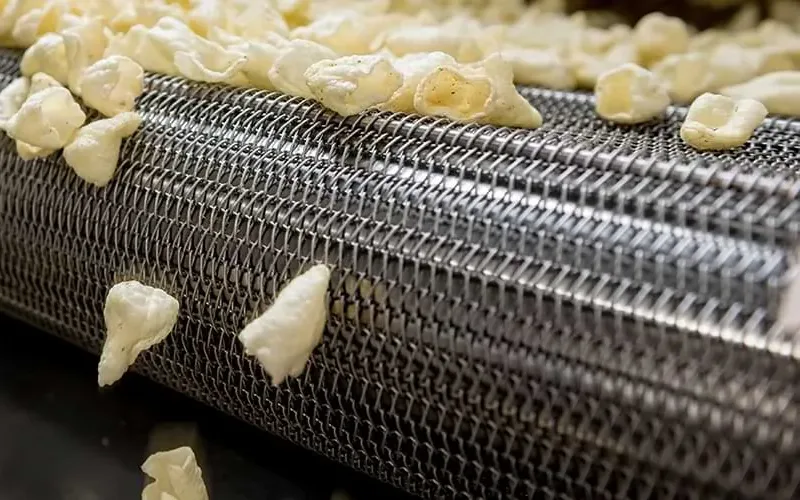
Food & Beverage
Pasteurizers, coolers and condensers for juice, sauces, brewing, distilling, liquid egg and edible oils.
+ Learn More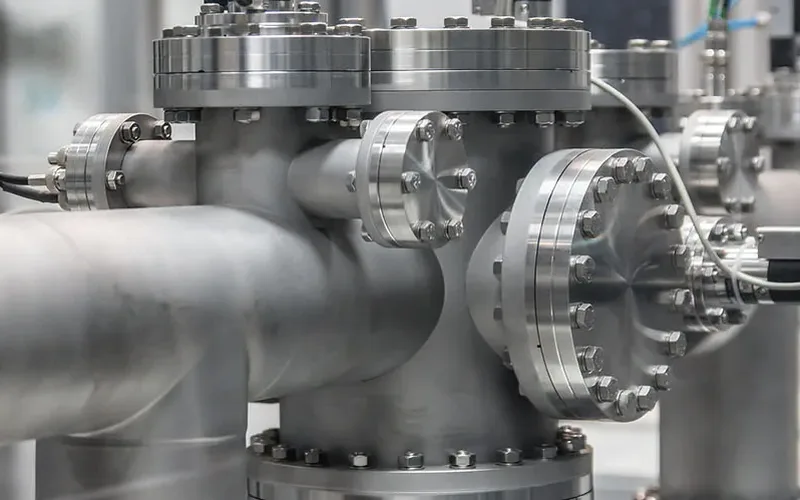
Applications
Pharmaceutical & Biotech
WFI and purified water, point-of-use cooling, bioreactor loops and extraction chilling, built to ASME BPE.
+ Learn More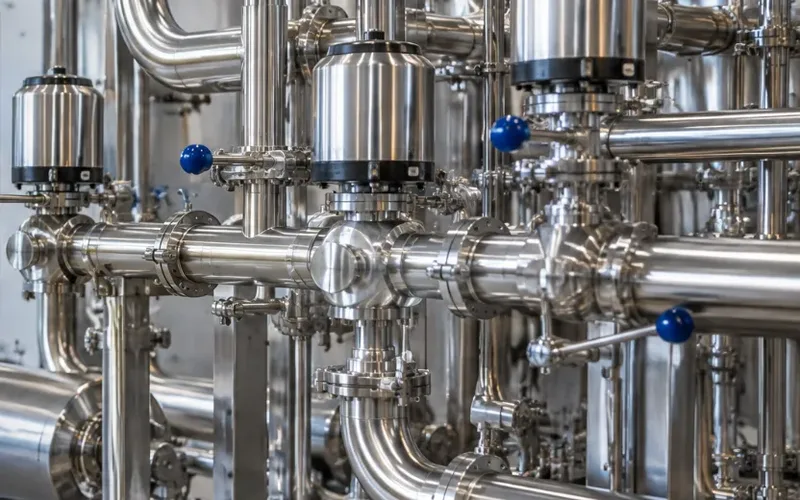
Applications
Water & Utility
The exchangers behind the process: high-purity water, CIP supply, clean steam and aseptic sterile barriers.
+ Learn More