
1-805-484-2992
Quotes - Engineering - SalesThe most heat transfer per square foot of floor
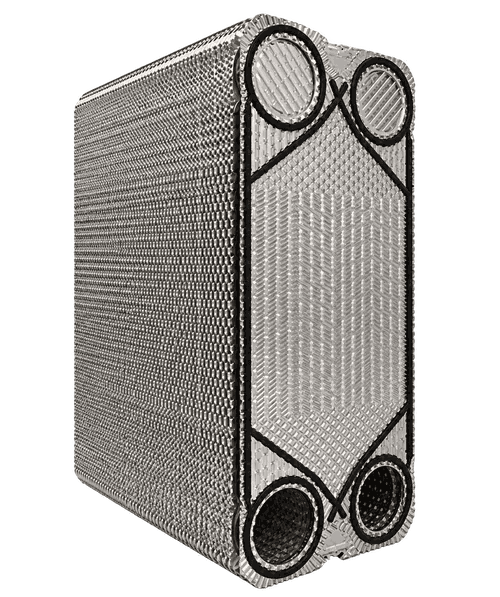
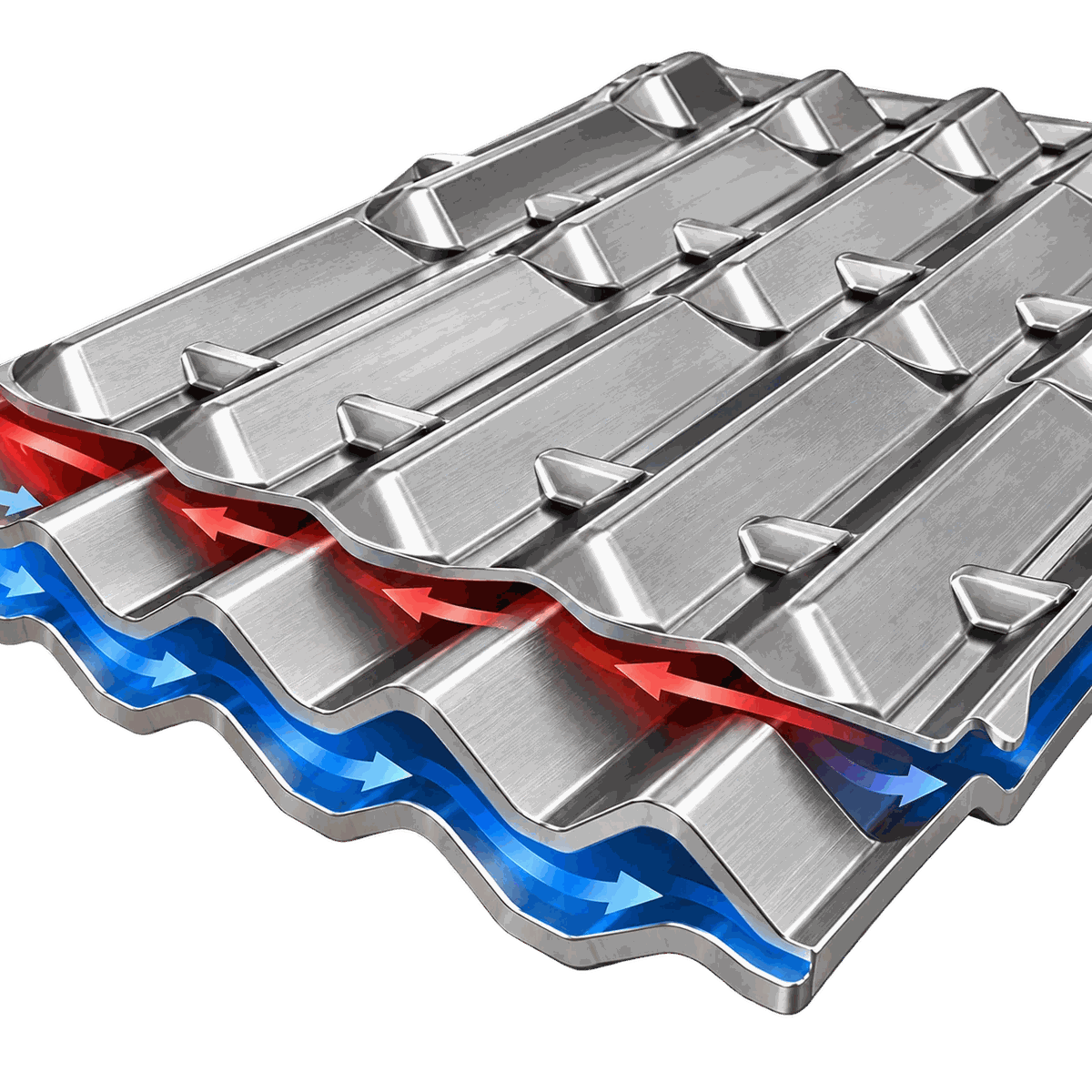
A sanitary plate and frame exchanger hangs a stack of thin, pressed stainless plates between a fixed and a movable frame plate and clamps them with tie bolts. Gaskets on each plate seal the edges and direct product and utility into alternating channels, so the two fluids run in true counterflow across the corrugated surface. Turbulence starts at low velocity, heat transfer coefficients run several times those of a tube, and the approach temperature can be brought to 2 or 3 F. Add a third fluid section and the same frame does regeneration, heating and cooling in one unit, which is why nearly every HTST pasteurizer is a plate exchanger.
Plates and gaskets
- 304L or 316L plates, 0.5 to 51 sq ft each
- Chevron, free-flow and wide-gap pressings
- Clip-on or glued gaskets in EPDM, nitrile, FKM
- Vented double gasket at every port keeps fluids apart
- Plate finish smooth as pressed; 32 Ra or electropolished on request
Frames and connections
- 304 stainless clad or solid stainless frames
- Tri-clamp studded ports 1" to 6", larger with sanitary flanges
- Stainless shrouds over the pack where required
- Tie bolts and bars in stainless, plate pack opens on the bars
- Multi-section frames with connection plates for regeneration
Ratings and codes
- 150 psig design typical, higher with heavier frames
- Gasket temperature limits generally 250 F for EPDM, higher for FKM
- 3-A plate exchanger standard where specified
- ASME U-stamp on the frame when required
- PED and CRN on request

Built For




Getting a sanitary plate exchanger right
Regeneration is the reason plates win
In a pasteurizer the raw product entering cold and the pasteurized product leaving hot can exchange heat with each other before any steam or chilled water is spent. A plate frame does this in a regeneration section, and 85 to 90 percent regeneration is routine on milk and juice, meaning nine-tenths of the heating and cooling energy is recovered. A shell and tube would need several shells in series to approach the same temperature cross. When the duty has a regeneration section, plates are almost always the answer; the shell and tube then takes the final heating with steam or the cold-side trim if those need higher pressure.
Plate pattern and channel gap set the product limits
Standard chevron plates run a channel gap in the range of 0.1" to 0.15", which is what produces their high coefficients and also what limits them. Water-like product with no solids runs freely. As viscosity climbs past a few hundred centipoise the pressure drop through those narrow channels rises faster than the heat transfer benefit, and by roughly 500 cP the plate is no longer the economical choice. Particulates larger than the gap will lodge at the contact points between plates. Free-flow and wide-gap pressings open the channel to roughly twice the normal gap and pass pulp, fiber and soft particulates up to about 3/8"; beyond that the duty belongs on the tube-in-tube page.
Plate sizing therefore starts from the product's viscosity at the cold end and its largest particle, then works back to the pattern and the number of channels. Sizing from flow and temperature alone is the common mistake and shows up as a pack that plugs in week two.
- Chevron plates: water-like product, highest coefficients
- Free-flow plates: light pulp and small particulates
- Wide-gap plates: about 2x gap, pulp and fibers to 3/8"
- Viscosity above roughly 500 cP: consider tube-in-tube
Gaskets are the working limit
Everything a plate exchanger can survive is set by its gaskets. EPDM handles hot water, CIP caustic and acid, and steam only at low pressure; it is the default for food and dairy. Nitrile covers fats and oils. FKM extends the temperature range and resists more aggressive chemistry at higher cost. All are supplied as food-grade compounds with FDA and 3-A material conformance, and the ports carry a vented double gasket so a failed seal leaks to atmosphere rather than to the other fluid. Plan on gasket replacement as a maintenance item; how often depends on temperature and CIP chemistry, with several years being typical in HTST service.
Opening, inspecting and growing the pack
Loosen the tie bolts, slide the movable frame plate back along the carrying bar, and every plate hangs free for visual inspection of both product and utility surfaces. That is a strong argument for plates in plants whose QA program wants to see the heat transfer surface periodically. The same open frame accepts more plates later: frames are ordered with spare bar length so a duty increase means adding plates and re-tightening rather than replacing the unit.
A plate frame sized for the product's viscosity and solids, gasketed for its temperature and chemistry, and framed with room to grow will carry a pasteurizer for decades. Call and talk it through with an engineer: 1-805-484-2992
Common FAQs
When product viscosity is above a few hundred centipoise, when particles exceed the channel gap, when either side sees steam above the gasket rating, or when the design pressure needs to exceed what the frame is rated for. Those duties move to shell and tube or tube-in-tube; everything water-like with a regeneration requirement stays on plates.
2 to 3 F between the hot outlet and the cold inlet is achievable in true counterflow. That is what makes regeneration of 85 to 90 percent practical in pasteurizers and why plate units are used for glycol chilling to within a few degrees of the glycol supply.
304L for most food and dairy, 316L for pharma, brine, wine, acidified sauces and anything carrying chlorides. Plates are smooth as pressed; a specified 32 Ra or electropolished finish is available for pharma and specific 3-A interpretations.
Yes, and it is the normal cleaning method. CIP at 160 to 180 F with caustic and acid cycles is within EPDM limits. Velocity in every channel should be at least 1.5 times the product velocity so the corrugation valleys get scrubbed; the CIP case is checked at sizing.
Units built to the 3-A plate exchanger standard are available where the inspection requires it, with the frame, plates, gaskets and connections all conforming. Many beverage and brewery applications only need the drainable, tri-clamp, food-grade-gasket build without the formal mark.
Yes when the ports are at the corners and the outlet is at the bottom, which is the standard sanitary arrangement. Residual film is removed by the CIP rinse; there are no pockets in a vertical plate.
Related
Sanitary Exchangers
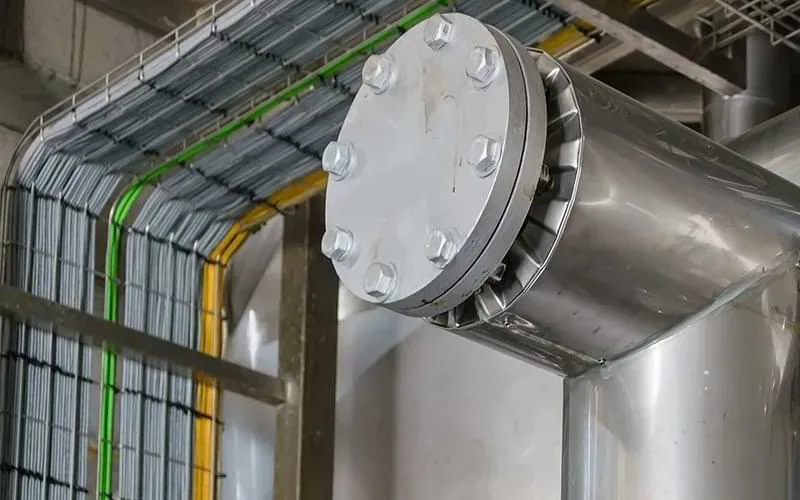
Shell & Tube
Straight tube, U-tube and double tubesheet bundles built for steam, pressure and a clean CIP return.
+ Learn More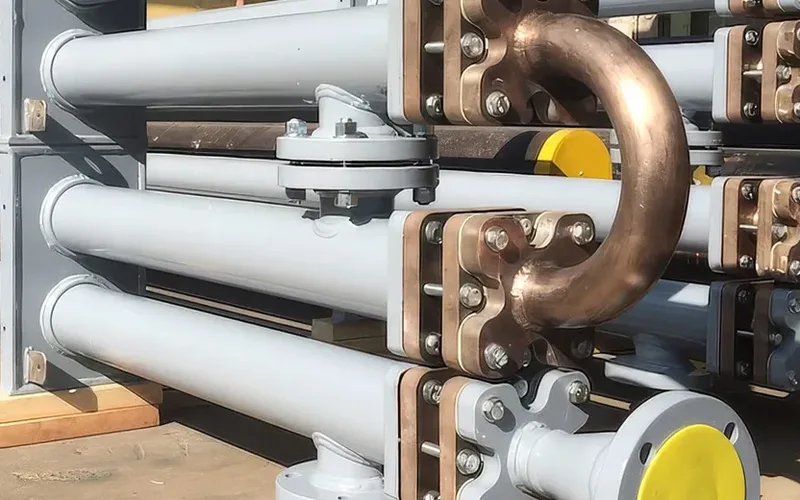
Sanitary Exchangers
Tube-in-Tube
One straight product tube inside a jacket: nothing to plug, nothing to bridge, and full counterflow.
+ Learn More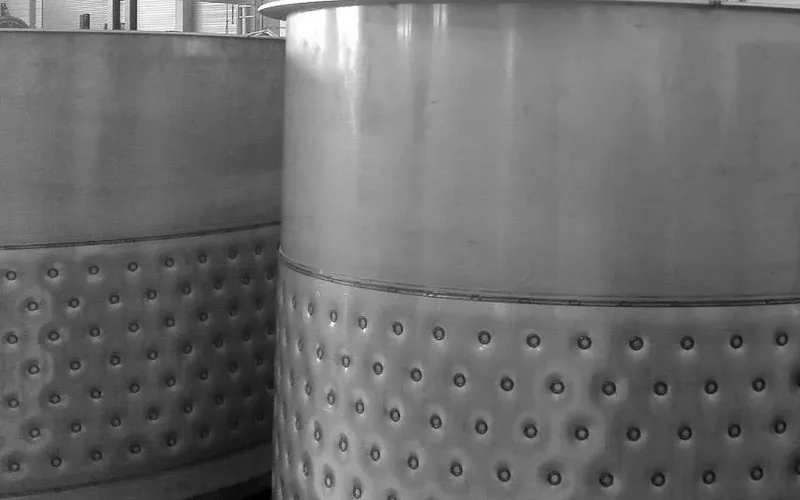
Sanitary Exchangers
Embossed Plate
Two stainless sheets welded and inflated into a heat transfer surface that goes wherever the tank needs it.
+ Learn More