
1-805-484-2992
Quotes - Engineering - SalesA welded plate surface instead of a coil or a dimple jacket
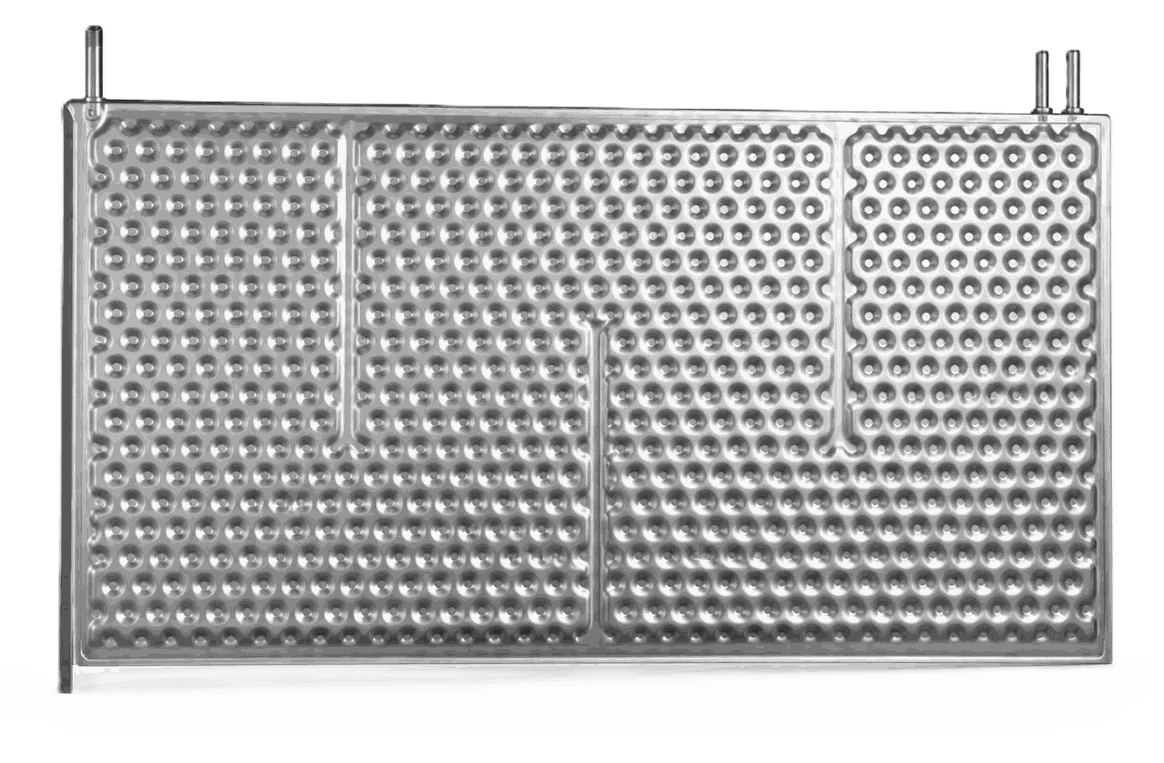
An embossed plate starts as two stainless sheets laid together, spot- or laser-welded in a repeating pattern, seam-welded around the perimeter, then hydraulically inflated until the unwelded areas pillow outward and become the flow passages. The result is a thin, rigid, fully welded panel with no gaskets, no tube-to-header joints and no bolted closures on the media side. The utility flows inside the pillows; the product touches the outside face. Because the panel is a flat sheet rather than a wound coil, it presents continuous surface contact to the product, holds a fraction of the media volume of a dimple jacket, and can be bent, cut out and shaped to fit a vessel, a drum or a tank that was never designed for it.
Panels are built double-embossed, pillowed on both faces, where the plate hangs in the product or bolts to a vessel, and single-embossed, with one face left flat, where the product must run against a smooth surface. Single panels reach roughly 60 by 240 inches, and larger surfaces are assembled from several panels manifolded together.
Panel construction
- Two sheets, welded pattern, seam-welded edge, inflated
- Double-embossed or single-embossed (one flat face)
- No gaskets, no headers, no bolted media joints
- Panels to about 60" x 240"; assemblies from several panels
- Cutouts, bends and curves made to drawing
Materials and finish
- 304L or 316L stainless on sanitary duty
- Carbon steel where the service allows it
- Titanium and higher alloys for aggressive media
- Product face polished or electropolished to a stated Ra
- 3-A finish on the product side when specified
Utility side
- Steam, hot water, chilled water or propylene glycol
- Ammonia or CO2 direct expansion on refrigeration duty
- Rating set by material, gauge and weld pattern
- Typical duties 100 to 150 psig and 300 F and above
- ASME U-stamp available; PED, CRN on request
Built For




Where embossed plate earns its place in a sanitary plant
Tank heating and cooling without a coil
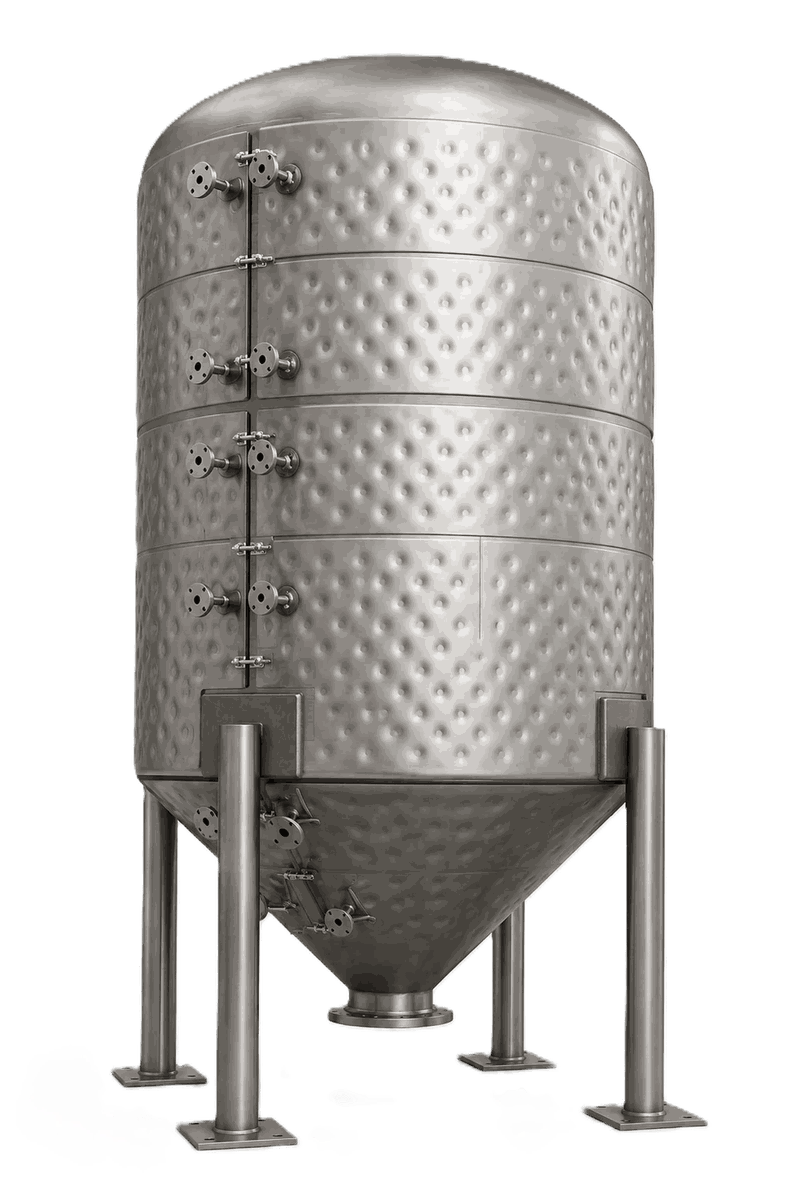
The classic sanitary use is bringing a tank of product to temperature or holding it there: warming a batch before filling, chilling milk or must after it arrives, holding a sauce at pack temperature, or pulling a brewery or winery tank down through fermentation. A coil does this by line contact, a few inches of tube touching a large volume of liquid, and it has to be sized generously to make up for it. A flat plate touches the product across its whole face. That is why an immersion plate of modest size will do the work of a coil several times its surface, and why the temperature it delivers is more even across the tank.
Fully welded, low volume, quick to respond
Two things about the construction matter to the process engineer. First, there is no gasket, no rolled tube joint and no flanged closure between the utility and the product; the only path is a weld, and the weld is tested before the panel leaves. Second, the media volume inside the pillows is far smaller than the volume in a dimple jacket or a coil of the same surface. Steam fills it in seconds, glycol changes it over in a single pass, and a refrigerant charge on direct-expansion duty is a small fraction of what a jacket would hold. Control loops settle faster and the utility side reaches full temperature before the product has time to notice the delay.
- Welded media path, no elastomer anywhere
- Small utility inventory, fast thermal response
- Direct-expansion ammonia or CO2 practical on the same panel
- Rated per panel, not from a generic catalog table
Product-side hygiene
Where the panel is single-embossed, the flat face is the product surface, and it is polished to the same Ra as any other sanitary contact surface, electropolished when the duty asks for it. A flat, welded face with no crevice is straightforward to spray-clean in place and to inspect by eye. A double-embossed panel hanging in a tank is still a welded stainless surface with no hidden corners, cleaned with the tank. The applications follow from that: dairy vat jackets, sanitary vessels with a 3-A finish on the product face, ice-bank and falling-film chilling for beverage, hydrocooling of produce where a fast pull-down keeps the crop, and jackets on wine and brewery tanks where the panel is added to a vessel that arrived unjacketed.
Choosing between the three arrangements
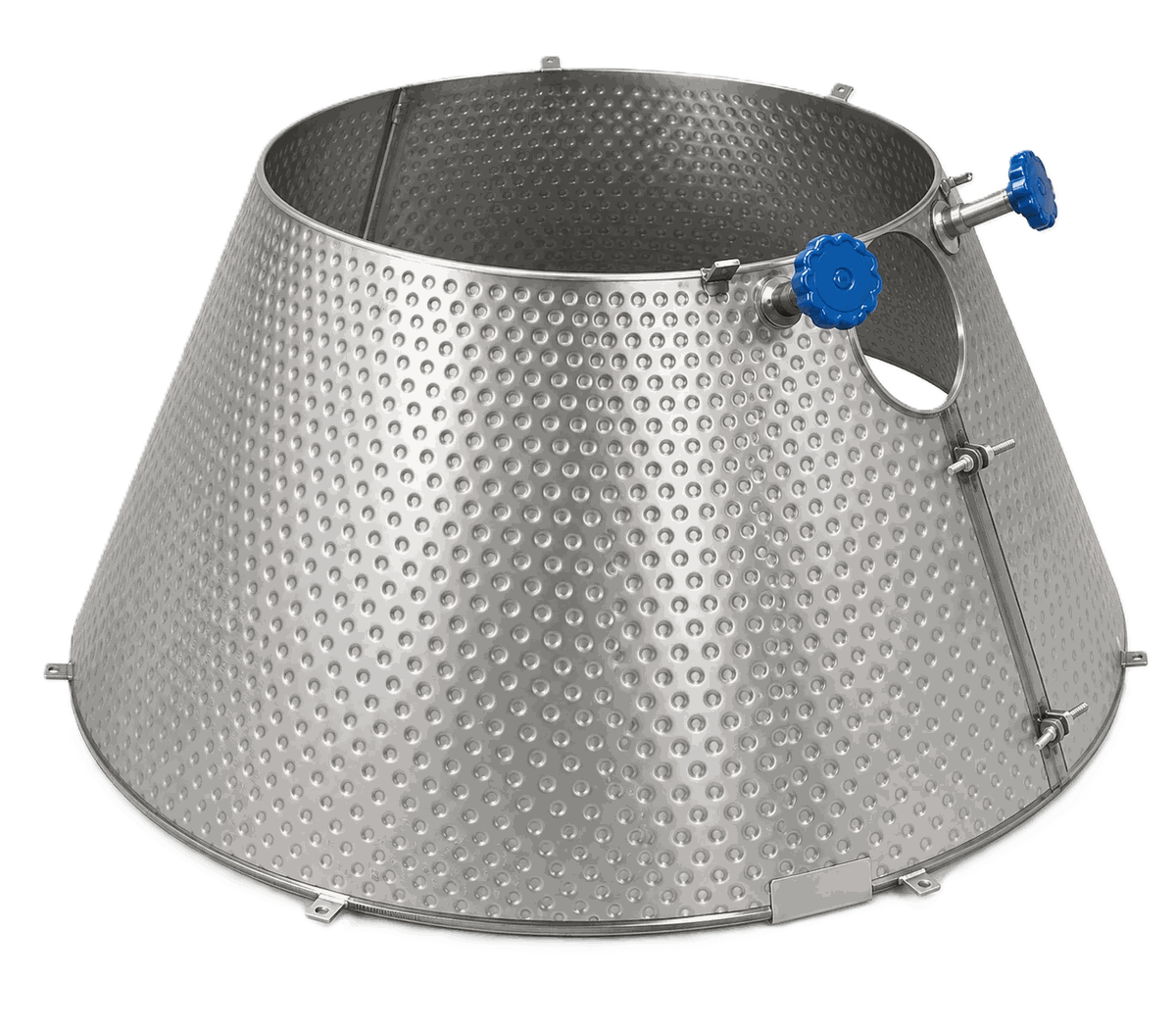
Immersion and clamp-on plates go on or into a tank you already own, or on a new tank where the jacket is cheaper to add as a panel than to build in. Integral panels are the vessel wall itself, or are welded into it, and are specified when the tank is being built or rebuilt. Custom panels cover everything that is not a rectangle: curved sections for a drum, cutouts around a manway, a plate that follows a cone bottom. Each page below gives the sizing basis, the details that decide the drawing and the questions that keep the quote from taking two rounds. Call and talk it through with an engineer: 1-805-484-2992
Common FAQs
A dimple jacket is a single sheet welded to the vessel wall with the wall as the second surface, so it holds a large media volume and can only go where the wall goes. An embossed plate is a self-contained two-sheet panel that stands on its own, holds much less media, and can be hung in a tank, clamped to it or welded in. The heat transfer is also better because both faces are shaped for flow.
It depends on the material, the sheet gauge and the weld pattern, and it is engineered for the duty rather than read from a table. Typical tank-duty panels run 100 to 150 psig and 300 F and higher; higher ratings are reached with heavier gauge and a tighter pattern. Ask for the rating with the quote and it will be stated on the drawing.
Yes. Direct-expansion refrigerant duty is a common use for double-embossed panels in ice banks, hydrocoolers and falling-film chillers, and the small internal volume is an advantage for refrigerant charge. The panel is rated for the refrigerant pressure and the welds are checked to match.
On a single-embossed panel the flat face is the product face and is polished to the Ra you specify. On a double-embossed immersion plate both pillowed faces touch the product, which is acceptable in most food and beverage tanks and is cleaned with the tank. For a 3-A finish on the product side, the single-embossed flat face is the usual choice.
That is one of the main reasons to choose it. An immersion plate hangs through the top opening and a clamp-on panel bolts to lugs on the outside with heat-transfer mastic between it and the wall. Neither requires cutting the vessel or recertifying it.
Roughly 60 inches by 240 inches as a single panel. Bigger surfaces are assembled from several panels with a common inlet and outlet manifold, which also lets the utility be zoned.
Related
Sanitary Exchangers
Shell & Tube
Straight tube, U-tube and double tubesheet bundles built for steam, pressure and a clean CIP return.
+ Learn More
Sanitary Exchangers
Plate & Frame
Close approach, regeneration and a pack that opens for inspection: the pasteurizer's construction.
+ Learn More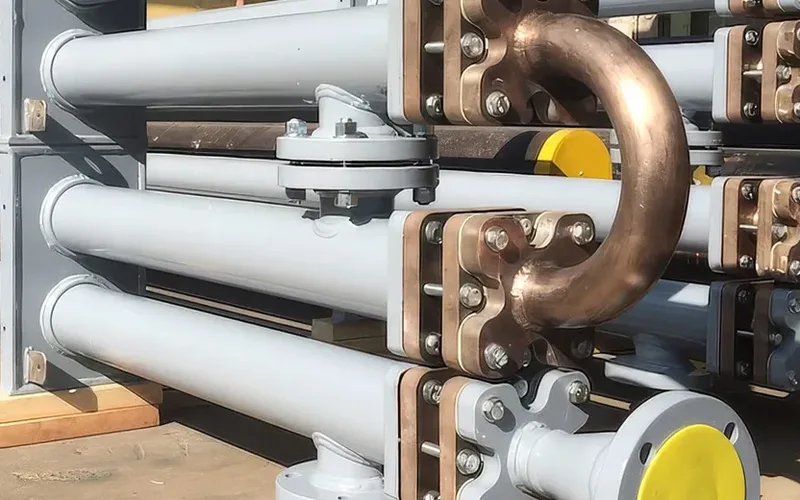
Sanitary Exchangers
Tube-in-Tube
One straight product tube inside a jacket: nothing to plug, nothing to bridge, and full counterflow.
+ Learn More