
1-805-484-2992
Quotes - Engineering - SalesThe rubber decides the maintenance interval
The stainless in a sanitary heat exchanger lasts decades. The elastomers last a year or two, and every gasket that fails does so at a product-contact joint, so the compound is a hygiene decision as much as a maintenance one. There are only four families in common use, EPDM, FKM, silicone and PTFE, and the choice among them is set by the CIP chemistry, the product's fat content, and the sterilization temperature, in that order.
Compliance is the other half. Food contact requires a compound formulated within FDA 21 CFR 177, which lists the permitted rubber and plastic ingredients. Pharmaceutical work often adds USP Class VI biological testing and 3-A 18-03 for multiple-use materials. A sanitary gasket is supplied with a compliance statement naming the compound and the regulations it meets, and that statement belongs in the unit's file.
EPDM
- Water, steam, caustic and CIP acids
- Swells and softens in fats and oils
- Continuous service 250 to 300 F
FKM
- Fats, oils, flavor solvents, most acids
- Weak in hot caustic, not steamed continuously
- Continuous service to 400 F
Elastomer families for sanitary duty
Compound and service
- EPDM: Water, steam to about 300 F, caustic, nitric and phosphoric acid; swells in fats and oils
- FKM (fluoroelastomer): Fats, oils, flavor solvents, most acids; poor in hot caustic and steam
- Silicone: Steam and hot air to 400 F, dry and clean service; soft, low abrasion resistance
- PTFE: Nearly universal chemical resistance, 400 F plus; no elasticity, creeps under load
- PTFE-enveloped EPDM: PTFE face on an elastomer core; chemistry of PTFE with some spring back
- NBR (nitrile): Oils and fats at moderate temperature; rarely on sanitary duty today
Limits and compliance
- Continuous temperature: EPDM 250 to 300 F; FKM 400 F; silicone 400 F; PTFE 450 F
- Low temperature: EPDM and silicone to well below 0 F; FKM stiffens near 0 F
- Food contact: FDA 21 CFR 177.2600 (rubber) or 177.1550 (PTFE) compounds
- Pharma: USP Class VI tested; 3-A 18-03 for multiple-use materials
- Replacement interval: Clamp gaskets 6 to 24 months; plate gaskets 1 to 3 years on CIP duty
- Color and marking: Compound identified by color code or molded marking; keep the datasheet
Pick for the CIP first, the product second
Choosing and maintaining sanitary elastomers
EPDM: the sanitary default
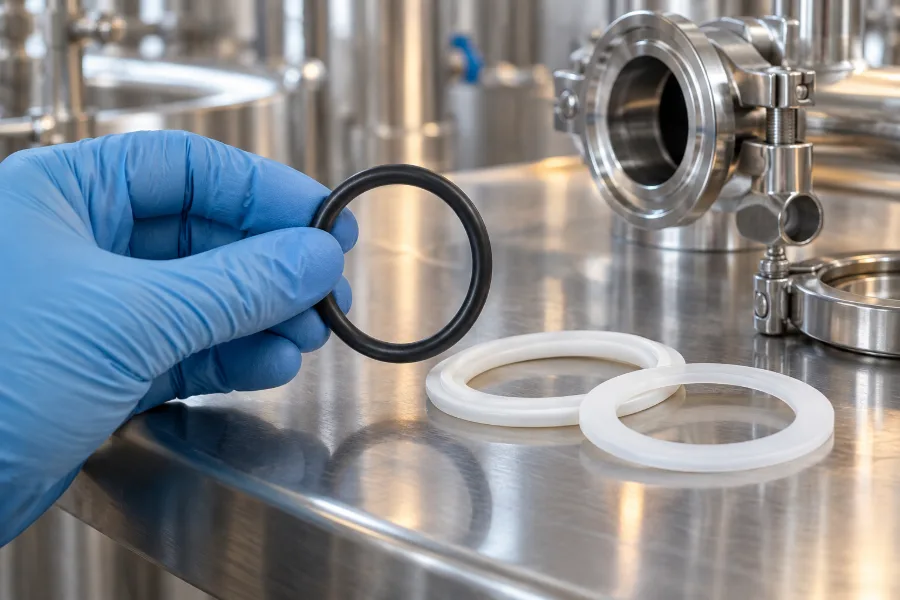
Ethylene propylene rubber resists hot water, steam, caustic and the nitric and phosphoric acids used in CIP better than any other elastomer at its price, which is why it is the standard compound on clamp gaskets, O-rings and plate gaskets in dairy, beverage and pharmaceutical water service. Peroxide-cured EPDM is the grade to ask for on sanitary duty; it takes steam sterilization at 250 F repeatedly and leaves less extractable residue than sulfur-cured grades. Its limit is oil. Fats, edible oils, essential oils and many flavor carriers swell it, soften it and shorten its life to months.
FKM, silicone and PTFE
FKM, sold under several trade names, is the fluoroelastomer for fats, oils and hydrocarbon solvents, and it handles higher continuous temperatures than EPDM. It is weaker in hot caustic, which limits it on plants with an aggressive alkaline CIP, and it should not be steamed continuously. Silicone has the widest temperature range and is the usual choice for joints that see clean steam often, but it is soft, tears easily and does not tolerate abrasion in a clamp that is opened weekly. PTFE is chemically inert and takes any CIP chemistry, but it is not an elastomer: it does not spring back, it cold-flows under clamp load, and a PTFE clamp gasket will weep after a few thermal cycles unless it is the enveloped type with an elastomer core.
- FKM: edible oil, cream at high fat, flavor solvents, CBD and extraction duty
- Silicone: clean steam joints, sterile vent connections, high-temperature dry service
- PTFE-enveloped: mixed chemistry where no single elastomer survives, at the cost of seal life
Compliance: FDA, USP Class VI and 3-A
For food contact the compound must be formulated from ingredients permitted under FDA 21 CFR 177, section 177.2600 for rubber articles and 177.1550 for PTFE. That is a formulation rule, and the supplier's compliance statement is the evidence. Pharmaceutical specifications add USP Class VI, a set of biological reactivity tests on the finished compound, and often ask for extractables data as well. 3-A 18-03 covers multiple-use plastic and rubber materials for dairy and food product contact and is what a 3-A unit's gaskets are documented against.
Plate gaskets: clip-on and glued
A gasketed plate exchanger has one gasket per plate, molded to the plate's channel pattern, and its retention method matters at regasketing time. Glued gaskets are bonded to the plate with an adhesive; they hold position well and are the traditional method, but replacement means cleaning the old adhesive off every plate, which is slow, and the adhesive itself must be a food-contact grade. Clip-on or clip-in gaskets are held by molded tabs that snap into slots on the plate edge, with no adhesive, and can be changed in the plant in a fraction of the time. On a unit that will be regasketed on a schedule, clip-on is worth specifying.
Specifying the elastomers
Name the compound for each joint type, the compliance you need (FDA, USP Class VI, 3-A 18-03), the SIP temperature the gaskets must survive, and the retention style on plate units. Ask for the compound datasheet and compliance statement with the unit. Call and talk it through with an engineer: 1-805-484-2992
Common FAQs
Over-tightening the clamp or using a gasket from a different standard than the ferrules. The gasket squeezes inward, creates a ledge, and product collects behind it. Use matched parts and tighten the clamp only enough to seat.
On the utility side any compatible compound will do; on the product side it has to be the compliant sanitary compound. Plants often use the same EPDM everywhere for simplicity, which is fine as long as the product-side parts are the certified ones.
By the supplier's color code or the molded marking; black EPDM and black FKM look alike. Keep the packaging or the datasheet with the spares, and never guess.
Peroxide-cured sanitary EPDM handles 250 F steam for hundreds of cycles. Each cycle ages it, so a joint that is steamed daily is replaced sooner than one steamed monthly. Sulfur-cured EPDM ages much faster and is not the right grade.
Related
Design & Fabrication
304L & 316L
How to pick between the two grades, what PREN tells you, and the alloys above them for chlorides.
+ Learn More
Design & Fabrication
Material Certs & Traceability
The documents that prove what was welded in, how it was finished and that it held pressure.
+ Learn More
Design & Fabrication
Materials
The metal in the tubes, the rubber in the joints, and the paper that proves which heat went where.
+ Learn More