
1-805-484-2992
Quotes - Engineering - SalesHeat exchangers that boil or condense on a sanitary surface
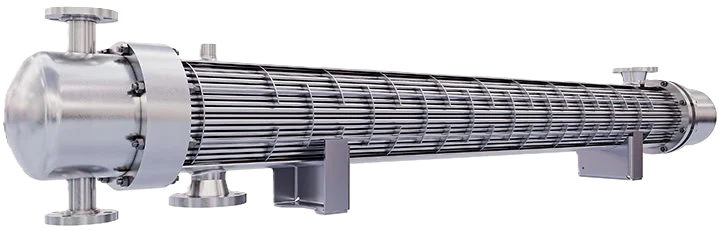
Most sanitary exchangers move heat between two liquids. This group changes phase on one side: an evaporator boils water or solvent out of a product to concentrate it, a condenser turns process vapor back into liquid, and a clean steam generator boils treated feedwater into steam clean enough to touch product. Each is a shell and tube or tube-in-tube unit at heart, but the vapor space, the level control, the venting and the drainage are what make them work, and those details are designed rather than assumed. Construction is 304L or 316L on the product side, polished and passivated, with tri-clamp or ASME BPE connections and the same seal-welded joints as any sanitary exchanger here.
Evaporators
- Falling film, rising film and forced circulation calandrias
- Single-effect and multiple-effect arrangements
- Product on the tube side, steam or vapor on the shell
- Vacuum operation for heat-sensitive product
- Sight glasses, spray balls and level nozzles
Vapor condensers
- Shell and tube, horizontal or vertical
- Vapor on the shell or in the tubes as the duty dictates
- Vent and non-condensable handling designed in
- Subcooling sections where required
- Condensate drains to the low point in the installed orientation
Clean steam generators
- U-tube reboilers fed with plant steam
- Culinary steam to 3-A 609 for direct food contact
- Pure steam to USP for pharma SIP
- Double tubesheet and 316L for pharma
- Separator, level control and blowdown in the package

Built For


What changes when one side boils or condenses
Vapor space, velocity and entrainment
Liquid-to-liquid design is about area and velocity. Phase-change design adds a third quantity: vapor volume. Steam at atmospheric pressure occupies about 1,600 times the volume of the water it came from, and at the vacuum many food evaporators run, far more. Shell nozzles, vapor domes and separator vessels are sized so vapor velocity stays low enough that liquid droplets fall back rather than carry over, because carryover in an evaporator is lost product and in a clean steam generator is contaminated steam. The tube layout is opened up on the vapor side and the inlet nozzle is fitted with an impingement plate so the first tube rows are not eroded.
Level, venting and non-condensables
A reboiler or clean steam generator holds a liquid level over the bundle and that level must be controlled: too low uncovers tubes and scales them, too high floods the vapor space and carries liquid over. Level nozzles, a gauge glass and a control connection are part of the design. On a condenser the enemy is air and other non-condensables that blanket the cold surface; a vent connection at the far end of the vapor path, sized and located so the gas is swept there, is what keeps a condenser at its rated capacity. Both details are common places where a plain liquid exchanger repurposed for phase change falls short.
- Level control connections on reboilers and generators
- Vent at the cold end of the vapor path on condensers
- Condensate outlet at the true low point
- Vacuum breakers where a cooling vapor space could pull vacuum
Drainability and cleanability with a vapor space
A sanitary vessel with a vapor space is cleaned by spray rather than by full flooding. Evaporator calandrias and clean steam generators carry spray ball connections positioned to reach the tubesheet, the tube ends and the vapor dome, and the internal surfaces above the liquid line are polished to the same finish as those below it because condensing product vapor wets them. Every low point drains through a sanitary valve, and the vessel is designed so no ledge or nozzle stub holds liquid when the unit is emptied. 3-A and ASME BPE both treat the vapor space as product contact, and the fabrication follows that.
Codes, utilities and where each unit fits
All three types are built as ASME Section VIII Div 1 vessels with a U-stamp, and in the sizes common in food and pharma plants that is routine. Vacuum service adds an external pressure calculation. Plant steam at 100 to 125 psig is the usual heat source for evaporators and clean steam generators, and cooling tower water, chilled water or glycol takes vapor condensers. Multi-effect evaporators reuse the vapor from one effect as the heating medium for the next, and a vapor condenser closes the train. The pages that follow take each unit in turn.
Phase change on a sanitary surface is a design conversation, not a catalog lookup. Call and talk it through with an engineer: 1-805-484-2992
Common FAQs
A heater raises product temperature without boiling it. An evaporator boils water or solvent out of the product to concentrate it, which means a vapor space, a separator, level control and a condenser downstream. The exchanger surface is similar; the vessel design around it is not.
Only if it was designed for it. Condensing needs an oversized vapor inlet, an impingement plate, a vent for non-condensables at the far end of the vapor path and a condensate outlet at the true low point. A liquid exchanger repurposed for vapor typically runs at a fraction of its rating.
The tube side in nearly every sanitary evaporator, so the product surface is a set of polished bores that CIP reaches. Steam or vapor from a previous effect heats the shell. Forced circulation and falling film designs both follow that arrangement.
Culinary steam under 3-A 609 is raised from treated feedwater in a generator with no plant-steam carryover and is fit for direct contact with food. Pure steam under USP is raised from purified water or WFI and its condensate meets WFI quality; it is used for pharma SIP. Both come from the same U-tube reboiler construction built to different feedwater and material specs.
Yes. Vacuum lowers the boiling point, which protects heat-sensitive product, and greatly increases vapor volume, which enlarges nozzles and separators. The shell is also calculated for external pressure. Most juice, milk and extract evaporators run under vacuum for the first reason.
Both are available. Food and dairy evaporators and culinary steam generators follow 3-A; pure steam generators and pharma condensers follow ASME BPE with 316L, electropolish and double tubesheets where the specification asks.
Related
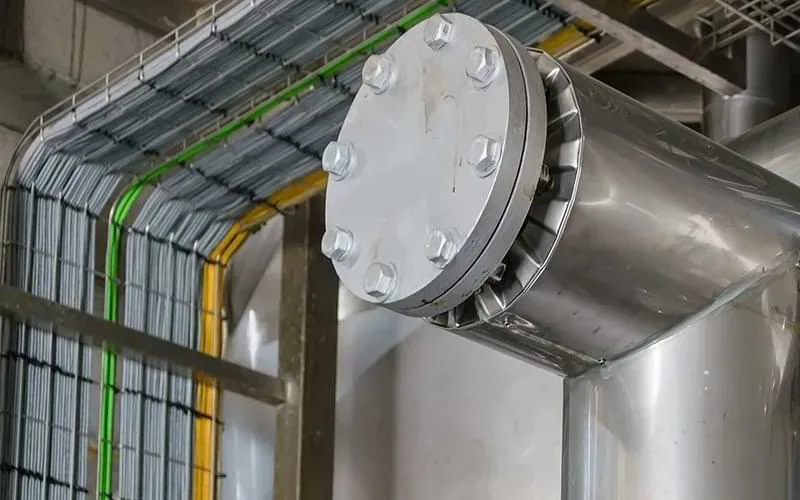
Sanitary Exchangers
Shell & Tube
Straight tube, U-tube and double tubesheet bundles built for steam, pressure and a clean CIP return.
+ Learn More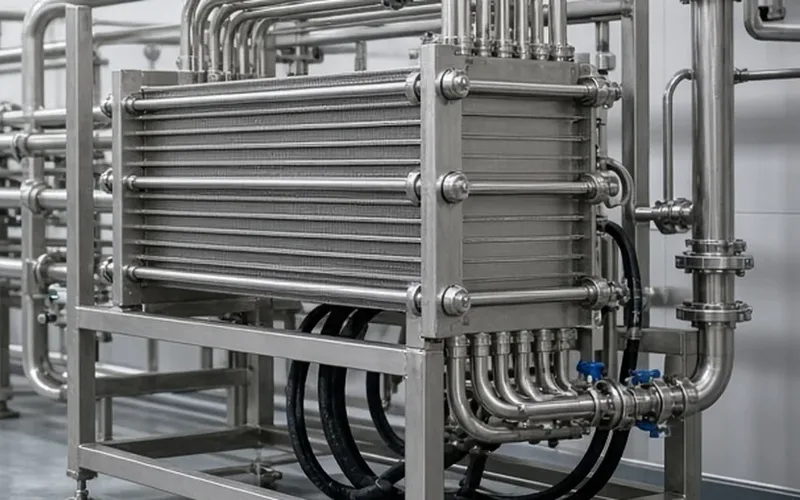
Sanitary Exchangers
Plate & Frame
Close approach, regeneration and a pack that opens for inspection: the pasteurizer's construction.
+ Learn More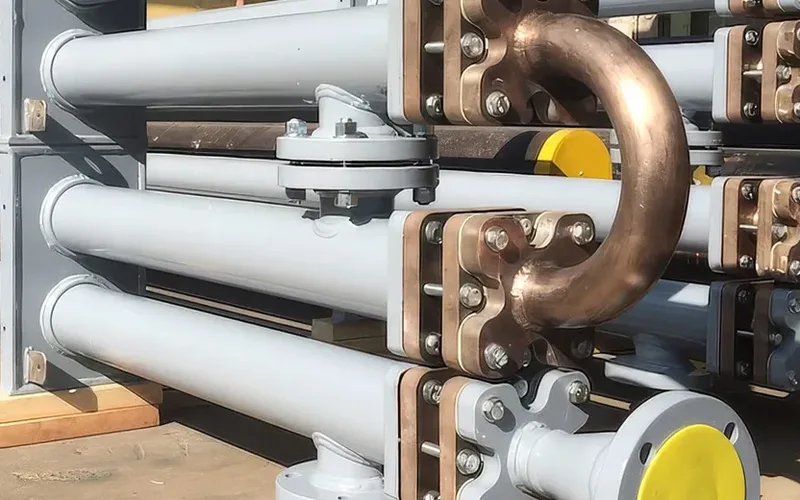
Sanitary Exchangers
Tube-in-Tube
One straight product tube inside a jacket: nothing to plug, nothing to bridge, and full counterflow.
+ Learn More