
1-805-484-2992
Quotes - Engineering - SalesA practice, not a published standard
Most food and beverage plants are not under a Grade A dairy inspector and do not run a pharmaceutical validation program. They run a HACCP plan, they get audited by their customers or a third-party scheme once or twice a year, and what they need from a heat exchanger is that it cleans in place, drains dry between runs, and does not shed anything into the product. That set of requirements is what the industry calls food-grade drainable, and it is worth defining precisely because the phrase means nothing on its own.
A food-grade drainable heat exchanger uses the same product-side geometry as a 3-A unit (no threads, no pockets, ground welds, sanitary fittings) and the same class of elastomers, but it is not registered, does not carry a symbol, and is not audited by a third party. The finish is typically 32 Ra on the product side and left rougher on the utility side. It costs less than a 3-A unit and much less than a BPE unit, and for a juice pasteurizer, a wort cooler or a sauce cooler it is the right tool.
Food-Grade Drainable
- Same product-side geometry, no symbol
- Customer or third-party scheme audits
- Material certs and hydrotest report only
3-A Verified
- Same geometry, symbol on the nameplate
- Third Party Verification by a conformance evaluator
- Registered, with drawings submitted and audited
What food-grade drainable should mean on a drawing
Product side
- Wetted metal: 304L standard; 316L for acid, brine or salt
- Finish: 32 Ra maximum, mechanical polish, no electropolish required
- Welds: Continuous, purged, ground flush on the product side
- Fittings: Tri-clamp or bevel seat; no NPT where product flows
- Gaskets: EPDM, FKM or silicone compliant with FDA 21 CFR 177
Installation
- Orientation: Self-draining as installed; slope stated on the drawing
- Drain: Low-point drain on the product side, valve or cap at the port
- Vent: High-point vent so the unit fills and empties without air lock
- Utility side: Drainable if the utility is not potable or the unit is stored cold
- Documentation: Material certs and hydrotest report; no symbol, no weld log
If it holds a puddle, it is not food-grade
Designing a food-grade drainable exchanger
Self-draining orientation
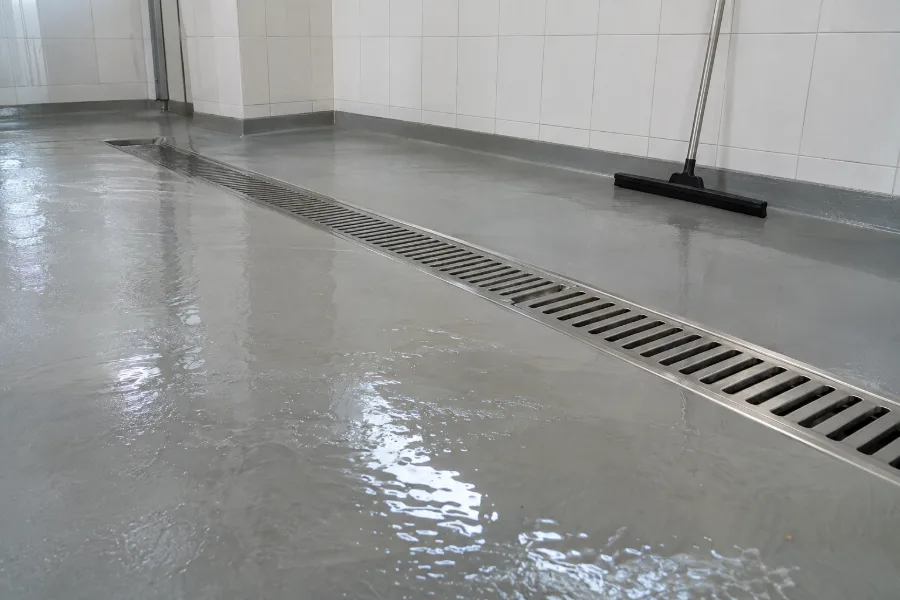
Drainability is decided by how the unit sits, and it is the item most often left off a food-grade order. A shell-and-tube unit with the product on the tube side drains through the low nozzle on the return head only if the tubes are level or fall toward that nozzle and the head has no sump below the nozzle centerline. On a horizontal unit it is usual to set the saddles so the shell falls about 1/8 inch per foot toward the product outlet. A vertical unit drains naturally through the bottom head.
Tube-in-tube units are the easiest to drain: the inner tube is a straight run or a gentle U with the outlet at the bottom, and the annulus drains the same way. Plate units drain through the bottom ports as long as the frame is plumb and the plate corrugations do not form a horizontal trap.
- Show the slope and the low-point drain on the general arrangement
- Put the product outlet at the low end of the tube bundle
- Avoid horizontal U-tube bundles on the product side unless rotated to drain
Crevice-free product side
Bacteria live where the CIP solution does not reach at velocity. On a heat exchanger those places are the root of a tube-to-tubesheet joint that was only expanded, the gap behind a gasket that sits proud of the bore, the thread of an NPT port, and the shadow behind a baffle if the product is on the shell side. Food-grade design removes all four: the tube joints are seal welded and polished, the ferrule bore matches the tube bore so the gasket sits flush, product ports use clamp or bevel-seat fittings, and product goes on the tube side or in a plate channel, never on a baffled shell side.
Elastomers and FDA 21 CFR 177
Every gasket and O-ring on the product side should be made of a compound that complies with FDA 21 CFR 177, the part of the code that lists rubber and plastic materials acceptable for repeated food contact. EPDM handles hot water and caustic CIP and is the default on dairy and beverage. FKM handles fats, oils and some flavor solvents that swell EPDM. Silicone tolerates the highest steam temperature but is softer and wears faster in a clamp joint. Ask for the compound name and its compliance statement, and keep it with the unit's records so the audit has an answer.
EHEDG as a reference
The European Hygienic Engineering and Design Group publishes guidelines on cleanable design and a test method for cleanability that many engineers find useful even in North America. Its guidance on gasket groove design, dead space, and surface roughness lines up with 3-A and BPE, and a designer who follows it will produce a unit that also satisfies a domestic auditor. EHEDG certification of a specific exchanger model exists and can be requested if an export customer asks for it, but it is not a substitute for 3-A where an American inspector expects the symbol.
Knowing when food-grade is enough
If the product will be sold under the Pasteurized Milk Ordinance, specify 3-A. If it is injectable or a pharmaceutical water, specify BPE. For juice, beer, wine, sauces, edible oil, sugar syrup and most cooked foods, a food-grade drainable unit detailed to the table above passes the audits the plant will actually face and saves the difference for the next project. Call and talk it through with an engineer: 1-805-484-2992
Common FAQs
Sanitary is the broad term for equipment designed to be cleaned and to protect the product. Food-grade drainable is one level of it, below 3-A and BPE in documentation and verification but built to the same product-side geometry.
Only where the product or the CIP chemistry carries chlorides: brine, tomato products, some sports drinks, and any chlorinated sanitizer step. Plain water, milk, juice and wort are fine on 304L.
Yes, if the gaskets are rated for it and the utility side is rated for the steam pressure. Silicone or high-temperature EPDM on the product side, and a stated SIP temperature on the order, are all it takes.
Material certificates for the product-contact metal, the gasket compliance statement, the hydrotest report, and a drawing that shows the slope and drain. That set answers nearly every customer audit question.
Related
Design & Fabrication
3-A Sanitary
Built and verified to 3-A 12-07 or 11-09, with the symbol on the nameplate and the paperwork behind it.
+ Learn More
Design & Fabrication
ASME BPE & Pharma
Surface finish grades, weld records and drainability rules from the bioprocessing standard, on an exchanger.
+ Learn More
Design & Fabrication
Sanitary Standards
3-A, ASME BPE and food-grade drainable: what each one requires, what it costs, and how to pick the right one.
+ Learn More