
1-805-484-2992
Quotes - Engineering - SalesHigh temperature, low water, no microbes to speak of
Edible oil is the food-plant duty that behaves least like food. Soybean, canola, sunflower, corn, palm, coconut and cottonseed oil all go through the same refining train: degumming and neutralization at 160 to 200 F, bleaching at 180 to 220 F, deodorization under vacuum at 450 to 500 F, then cooling to 100 to 120 F for storage or to a crystallizer for shortening and margarine. The fluid is clean, has almost no water, does not support microbial growth and is not corrosive, so the pressure vessel rules and the metal temperature govern the design more than 3-A geometry does.
What the oil does care about is oxidation and flavor. Every hour above 300 F in contact with air raises peroxide value, so an economizer that drops deodorized oil from 480 F to 200 F in one pass under nitrogen protects the product while it pays for itself. The utility is thermal fluid at 550 to 600 F or high-pressure steam on the final heater, and tower water or chilled water on the coolers. Because the water content is so low, 304L is the usual product-contact material, with 316L reserved for the neutralization section where caustic and soapstock are present.
Request a Quote
The economizer recovers 60 to 80 percent of the deodorizer load
Deodorized oil at 450 to 500°F runs counterflow against bleached feed at 180 to 220°F, so the final heater only closes the last 60 to 100 degrees. A 30 to 50 degree approach sizes it, and the 300 degree metal swing demands a U-tube bundle.
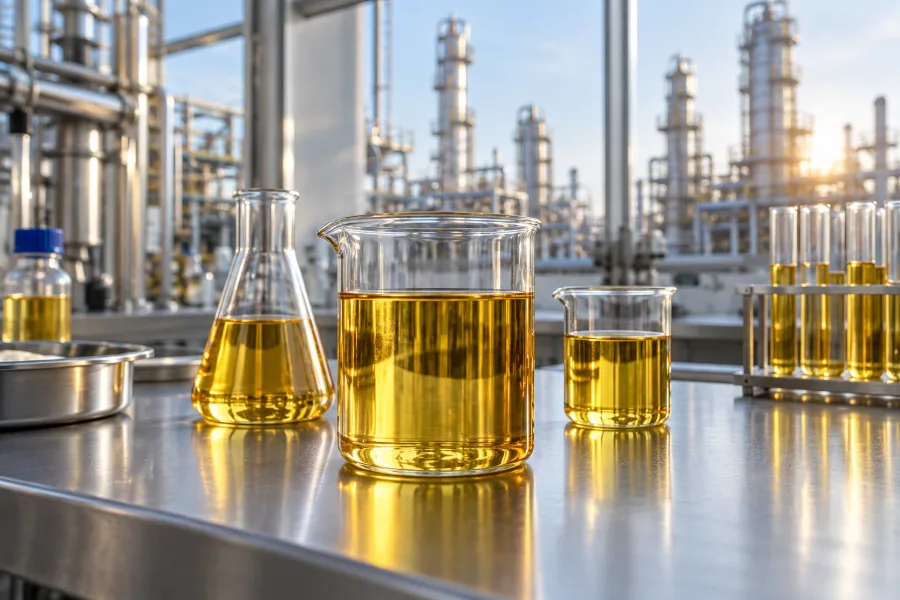
Refining heaters and economizers
- Bleacher and neutralizer feed heaters, 160 to 220 F on 50 to 150 psig steam
- Oil-to-oil economizer, deodorized 480 F against bleached feed at 200 F
- Final heater on thermal fluid at 550 to 600 F or 600 psig steam
- Expansion joint or U-tube bundle for the 300 degree metal swing
- Nitrogen-blanketed, fully drainable, 304L or 316L by section
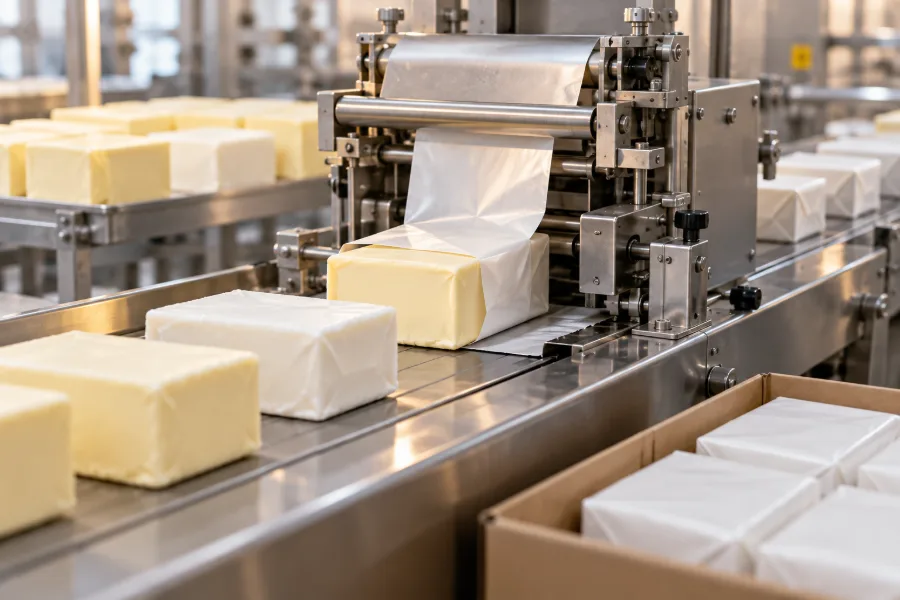
Coolers and crystallizers
- Refined oil cooler to 100 to 120 F for storage, tower water
- Pre-crystallizer cooling of shortening and margarine feed to 110 to 130 F
- Winterization chilling to 40 to 45 F for wax and stearin removal
- Low wall-to-bulk approach so the fat does not set on the tube
- Removable bundle, steam-out capable for a hardened fat
Recommended construction by oil and fat duty
Temperature and pressure rating pick the family; viscosity and the risk of the fat solidifying on the wall pick the geometry inside it.
| DUTY / CONDITION | RECOMMENDED CONSTRUCTION | WHY |
| Oil-to-oil economizer, deodorizer outlet to feed, 400 to 500 F | Straight Tube | Fixed tubesheets with a shell expansion joint carry the thermal swing; counterflow in one long shell recovers 60 to 80 percent |
| Final oil heater on thermal fluid or high-pressure steam | U-Tube | Bundle expands freely at 550 F; thermal fluid stays on the tube side and the bundle pulls for inspection |
| Bleacher and neutralizer feed heating, 160 to 220 F | Gasketed Plate | Low-pressure steam or hot water on a clean oil at moderate temperature; compact and easy to add plates to |
| Refined oil cooling to storage, tower or chilled water | Double-Wall Plate | Positive separation from cooling water where the plant will not risk water in a finished oil tank |
| Shortening, margarine and palm stearin, sets on a cold wall | Single Tube-in-Tube | Large bore, hot water in the annulus at a small approach, steam-out and drain when the line stops |
| Deodorizer and fatty acid distillate vapor, vacuum condensing | Vapor Condenser | Shell-and-tube condenser rated for vacuum with fatty acid drainage and non-condensable venting |
Designing the oil train around the economizer
The economizer is the exchanger that decides how much steam or thermal fluid the refinery burns. Deodorized oil leaves the column at 450 to 500 F and bleached feed arrives at 180 to 220 F; running them counterflow through one long shell-and-tube exchanger takes the feed to 400 F or more and the product down to 240 F or less. That is 60 to 80 percent of the deodorizer's heat load recovered, and the final heater only has to close the last 60 to 100 degrees. The economizer is sized on a 30 to 50 degree terminal approach, because oil-to-oil coefficients are modest and a tighter approach buys little duty for a great deal of surface.
Metal temperature drives the mechanical design. A fixed-tubesheet shell-and-tube with the product oil at 480 F on one side and 200 F on the other has a differential expansion of over half an inch on a 20 foot bundle, so the shell gets an expansion joint or the bundle is U-tube. Design pressure is set by the thermal fluid system or the steam, not the oil, and the unit is built to ASME Section VIII with a food-grade drainable, polished product side rather than to a dairy 3-A standard.
Viscosity on the cold end is the other constraint. Refined soybean oil is 60 cP at 70 F and 8 cP at 200 F; palm oil is a paste at 70 F. A cooler that has to bring oil to 100 F on tower water at 85 F is working on a 15 degree approach against a fluid that is thickening as it cools, so the cold end is sized deliberately, velocities are kept above 3 ft/s in the tubes, and any fat that can solidify gets hot water rather than cold water on the utility side with a means to steam the unit out on shutdown.
The common mistake is putting cold tower water against warm shortening or palm stearin. The fat sets on the tube wall in the first pass and the pressure drop climbs until something lets go. HeatX puts tempered water at 10 to 20 degrees below the fat's melting point on those coolers and brings the temperature down in stages.
Recovery first, then the last hundred degrees
Materials: where 304L is enough
With no free water and no chloride, refined oil does not pit stainless, and 304L tubes and shells are the norm on economizers, final heaters and product coolers. The neutralization section is the exception: caustic soda, soapstock and wash water at 180 F are present, and 316L on the product side is worth the difference there. Carbon steel is acceptable on thermal fluid and steam sides that never see product.
Thermal fluid versus steam
Reaching 480 F on steam takes 600 psig and a boiler most food plants do not have; thermal fluid at 550 to 600 F does it at a few psig. The exchanger is then rated for the thermal fluid loop pressure, the fluid goes on the tube side so a tube leak puts oil into thermal fluid and not the other way, and the film temperature on the fluid side is kept under its degradation limit by velocity.
Cleaning and inspection
Oil exchangers are not CIP-cleaned on a shift schedule the way a juice pasteurizer is. They are drained, flushed with hot oil at changeover, and opened on a maintenance interval for polymerized oil; a removable bundle or straight tubes with bonnets make that a morning's work.
What to send
Oil type, flow in lb/h or gpm, inlet and outlet temperatures on both streams, thermal fluid or steam conditions, cooling water temperature, and which unit in the train it is: economizer, heater, cooler or crystallizer feed. Call and talk it through with an engineer: 1-805-484-2992
Common FAQs
Rarely. Oil has no water activity to support growth, and most refineries specify a food-grade drainable design to ASME Section VIII with polished product surfaces. HeatX builds to 3-A where the plant's quality system asks for it, typically on finished oil coolers feeding a bottling line.
60 to 80 percent of the deodorizer heating load on a counterflow shell-and-tube with a 30 to 50 degree terminal approach. On a 20,000 lb/h line that is roughly 2 to 3 million Btu/h the final heater no longer supplies.
Gasketed plates are fine up to about 250 F on bleacher and neutralizer feed heating and on coolers. Above that the gasket material and the pressure rating run out, and the economizer and final heater are shell-and-tube.
Tempered water on the utility side at 10 to 20 degrees below the fat's melting point, staged cooling, tube velocity above 3 ft/s, and a hot water or steam-out connection so the unit is cleared when the line stops.
Related
Applications
Juice & Beverage
Pasteurize at 185 to 195 F, hot fill at 180 F or cool to 40 F, with pulp in tubes and clear product on plates.
+ Learn More
Applications
Sauces & Particulates
Tube-in-tube and multi-tube exchangers, bore chosen for the biggest piece and velocity for the slowest one.
+ Learn More
Applications
Brewery & Distillery
Wort chillers, must coolers, mash coolers, still condensers and dephlegmators for brewing and distilling.
+ Learn More