
1-805-484-2992
Quotes - Engineering - SalesOpen bores from head to head
A straight tube unit fixes a tubesheet at each end of the shell and runs the tubes straight between them. Remove the two channel heads and every tube is a clear line of sight: a brush, a pig or a borescope goes in one end and comes out the other. That is the reason the straight tube pattern is chosen for products that foul, for plants whose QA program wants visual verification of product-contact surfaces, and for services where a plugged tube must be cleared without pulling the bundle.
The cost of that access is thermal growth. With both tubesheets welded to the shell, the tubes and shell expand at different rates whenever the two fluids are far apart in temperature. Up to a differential of roughly 100 to 150 F between mean tube and shell metal temperatures the stresses are tolerable in stainless; beyond that the shell gets an expansion bellows, or the duty moves to a U-tube.
Single-pass straight tube units are also the natural choice for product with a directional flow preference, such as viscous streams that should not reverse in a return head, and for units that will be mounted vertically to drain by gravity.
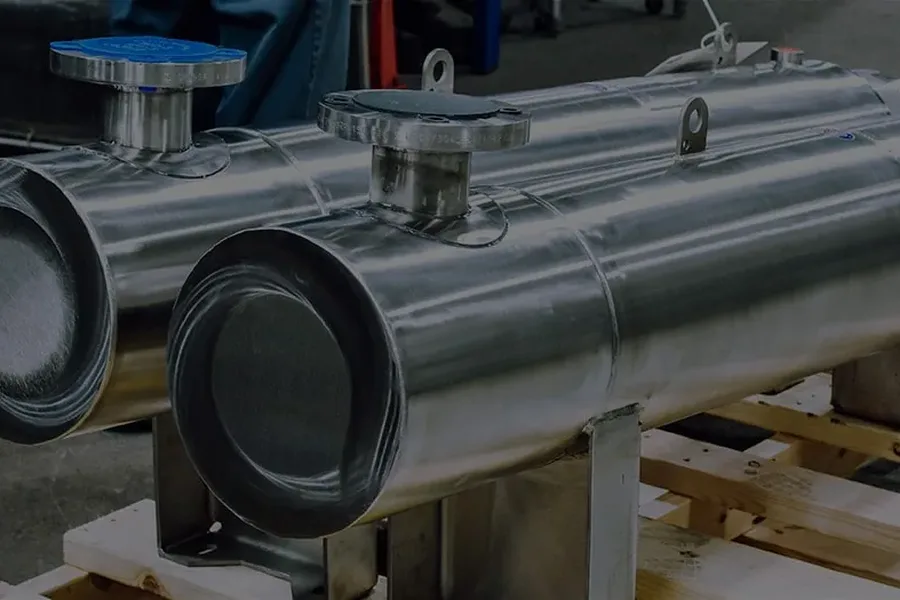
When the sanitarian asks to see the inside of the tubes, a straight tube unit answers with two clamps and a flashlight.
Fixed tubesheets, open bores, seal welded joints, no bundle to pull.
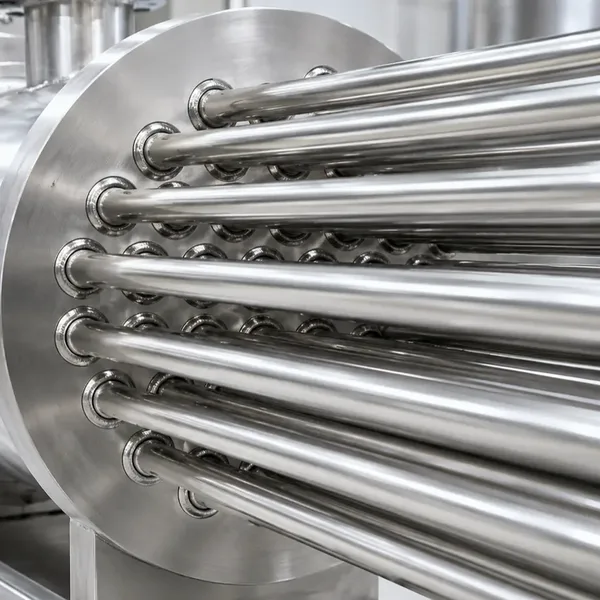
Open bores you can inspect
- Brush, pig or borescope every tube end to end
- Clear line of sight once both heads come off
- Fabrication Ra readings give a baseline for later audits
- Failed tubes plugged or cut out and replaced
- Shell side stays sealed while the heads are open
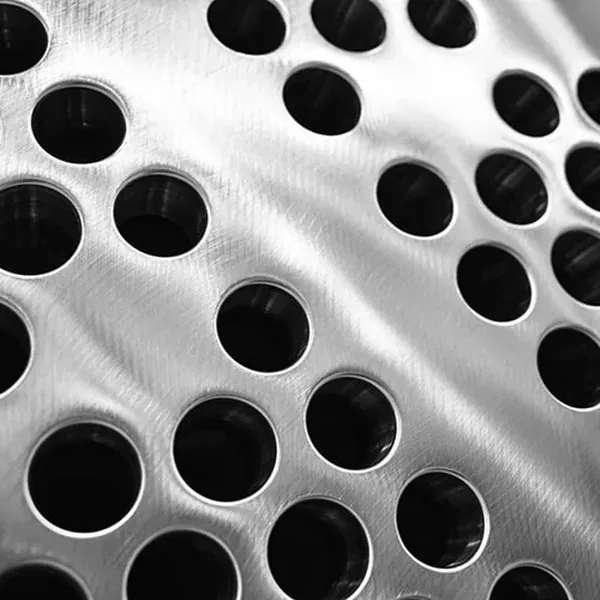
Built for fouling product
- Mechanical clean between CIP cycles, no dismantling
- Larger bores tolerate partial fouling before velocity drops
- Single pass vertical layout drains by gravity
- Seal welded joints ground flush on the product face
- Pitched horizontal mounting with low-point drains on both heads
Specify It With



Straight tube, typical sanitary build
What follows is the build a straight tube sanitary unit usually carries, from tube finish to the joint and thermal growth provision. Compare it with your specification and tell us where yours differs when you request a quote.
| Feature | Detail |
| Tube OD and wall | 3/4", 1" or 1-1/2" OD, 16 or 18 gauge, seamless or bead-removed welded |
| Tube internal finish | 32 Ra standard; 20 Ra or electropolished for pharma |
| Tube-to-tubesheet joint | Orbital TIG seal weld, ground and polished flush on the product face |
| Passes | 1, 2 or 4 tube passes; single pass for vertical gravity-drain installs |
| Shell diameter and length | 3" to 24" typical, up to 48"; 24" to 240" tube length |
| Design pressure | 150 psig both sides typical; higher on request |
| Design temperature | 350 to 375 F typical; CIP 160 to 180 F, SIP 250 F plus |
| Thermal growth | Fixed tubesheets; shell bellows above roughly 100 to 150 F metal differential |
| Connections | Tri-clamp or ASME BPE product side, tri-clamp, flange or NPT utility side |
| Codes | ASME VIII Div 1 U-stamp, 3-A 12-07, TEMA C; PED, CRN on request |
When straight tube is the right sanitary answer
Fouling product and mechanical cleaning
Sauces, purees, protein-rich dairy streams and sugar syrups all lay down films that CIP removes most of the time and not all of the time. When a product is known to bake onto the wall, straight tubes let the plant add a mechanical clean, brush or pig, between CIP cycles without dismantling anything except the heads. Tubes of 1" or 1-1/2" OD are usual here because brushes and pigs are easier to run in the larger bore and because the larger diameter tolerates a partial fouling layer before velocity collapses.
Inspection programs and validation
Pharma and dairy QA programs increasingly write a periodic borescope inspection of product-contact surfaces into the maintenance plan. A straight tube unit is the only shell and tube geometry where every inch of tube bore can be seen and recorded; U-bends hide the return from any fiber optic scope. Profilometer readings taken at fabrication on both ends of representative tubes give the baseline that later inspections compare against.
- Both tubesheet faces exposed with heads off
- Full-length borescope path through every tube
- Baseline Ra readings shipped with the unit
- Tubes plugged or replaced individually if ever needed
Managing thermal expansion honestly
The stress question is worth stating plainly. In a fixed-tubesheet unit the tubes and shell are locked together, so a hot shell around cold tubes puts the tubes in tension and the tubesheet in bending. Stainless has enough ductility that moderate differentials are fine; the design calculation under ASME UHX tells whether the actual duty needs a bellows. Steam on the shell heating a cold product start-up is the case that most often pushes a straight tube toward a bellows or toward the U-tube page. Chilled water and hot water services rarely do.
A shell bellows is a legitimate answer and is used on sanitary units, but it adds a convolution on the utility side that is not polished and cannot be product-contact. If the process would ever want to swap sides, choose the U-tube instead.
Orientation and drainability
Straight tube units drain best mounted vertically with product entering the top head and leaving the bottom, which gives gravity a straight run through every tube. Horizontally mounted units are pitched roughly 1/8" per foot toward the outlet head and carry a low-point drain on both heads and on the shell. Multi-pass horizontal units need each pass partition arranged so no pass traps liquid on the return; that detail is checked on the drawing before fabrication, not in the field.
Straight tube is the simplest sanitary shell and tube to specify and the easiest to keep clean by every method a plant owns. Call and talk it through with an engineer: 1-805-484-2992
Common FAQs
Straight tube when you need to brush, pig or borescope the tubes, or when a single-pass vertical drain layout matters. U-tube when the utility is steam or the two sides are far apart in temperature and you would rather let the bundle grow freely than add a bellows. Both are built polished, seal welded and drainable.
Yes. Release the tri-clamps on both channel heads, swing or lift them clear, and every tube is open end to end. Nothing else is disturbed and the shell side stays sealed.
3/4" for water-like products and maximum surface; 1" for light pulp, small particulates or products you expect to clean mechanically; 1-1/2" for soft solids up to about 1/2" or for very viscous product. Larger bores lower velocity for the same flow, so the pass count is adjusted to hold 4 to 8 ft/s.
Individual tubes can be plugged from the tubesheet face, and on straight tube units a failed tube can be cut out and replaced through the head opening. Bundle replacement is not the only option as it is on a U-tube.
Yes. 3-A 12-07 covers shell and tube exchangers of this construction provided the product side is polished, seal welded, drainable and fitted with sanitary connections. The bellows, if one is used, is on the utility side and outside the product zone.
Related
Sanitary Exchangers
U-Tube
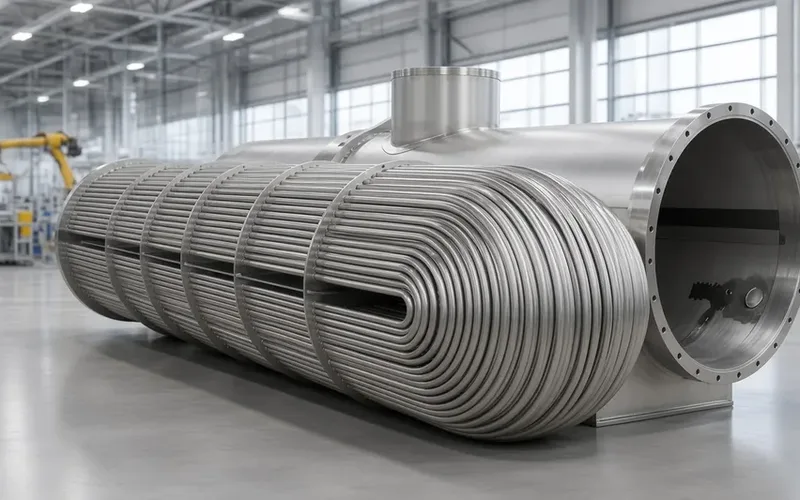
One tubesheet, a bundle that grows on its own, and a shell that never sees an expansion joint.
+ Learn More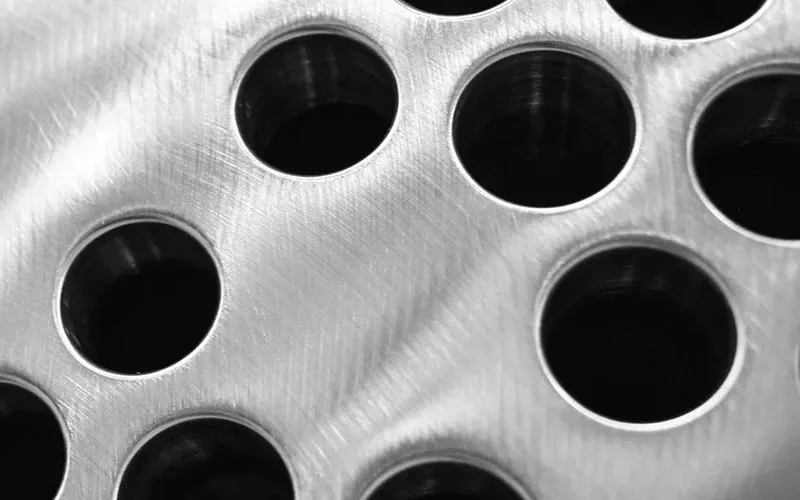
Sanitary Exchangers
Double Tubesheet
Two tubesheets, one open gap, and no path by which utility water can ever reach product.
+ Learn More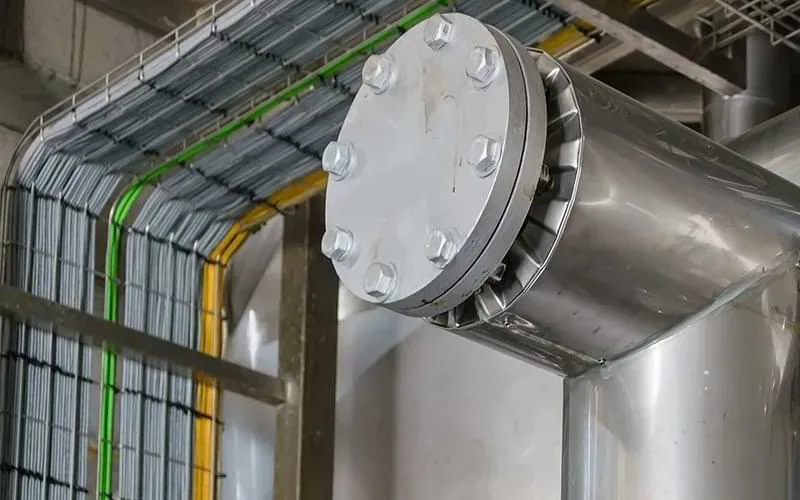
Sanitary Exchangers
Shell & Tube
Straight tube, U-tube and double tubesheet bundles built for steam, pressure and a clean CIP return.
+ Learn More