
1-805-484-2992
Quotes - Engineering - SalesThe leak path, and why a second tubesheet closes it
In a conventional shell and tube unit a single tubesheet separates the product in the tubes from the utility in the shell. Every tube joint on that sheet is a potential path between the two, and a joint that weeps admits shell-side water, glycol or steam condensate straight into the product with no warning until a lab result comes back. In a double tubesheet unit there are two tubesheets at each end with an air gap between them. A tube joint that fails on either sheet leaks into that gap, drips out of the vent, and is seen on the floor long before it reaches the other fluid.
That is the whole idea, and it is why double tubesheets are written into most WFI and purified water system specifications, most ASME BPE process exchangers, and a growing share of dairy and juice pasteurizer specifications where regulatory guidance treats the utility side as a contamination source.
The construction adds cost: two tubesheets per end, a longer shell, more welding, more finish work. It also removes an entire failure mode from the risk assessment, which is usually why it is specified.
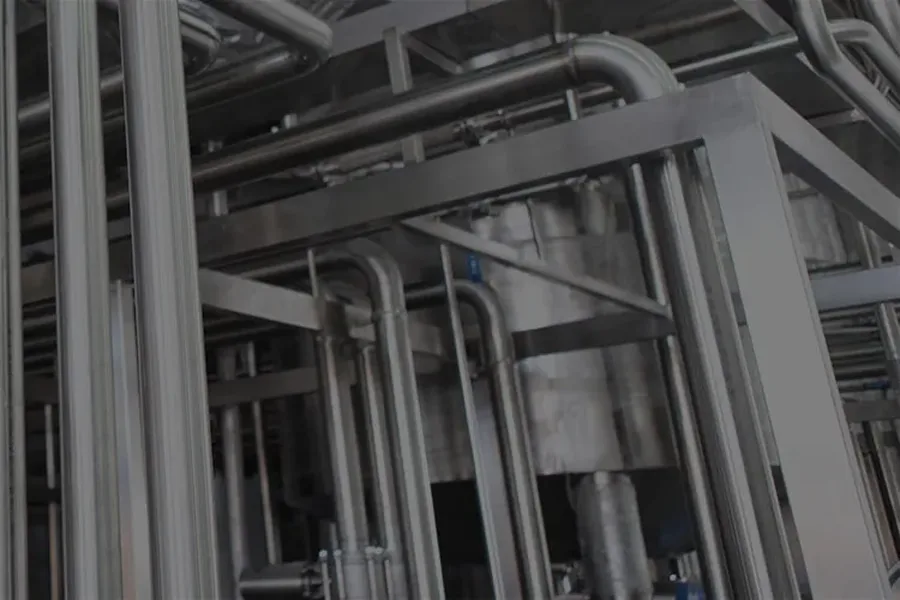
A tube leak in a double tubesheet unit ends up on the floor, not in the batch. That is the difference a second sheet buys.
Specified on WFI, purified water, pharma process and inspected dairy pasteurizers.
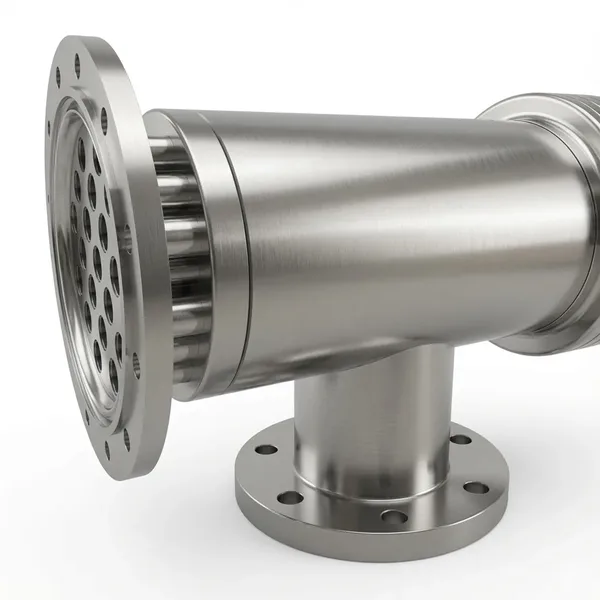
Leak detection you can see
- Failed joint drips from the vent onto the floor
- Drip tray or conductivity cell logs any leak
- Gap stays dry in normal operation
- Any liquid at the port signals a joint leak
- Both sides pressure tested to show the gap stays dry
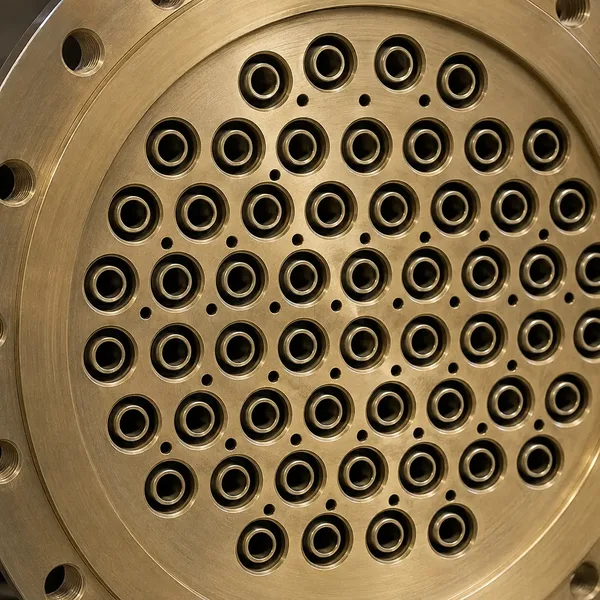
Product side that stays product side
- Utility water cannot reach product through any joint
- Product and shell sheet joints are fully independent
- Accepted answer where heating media counts as contaminant
- Specified on WFI, purified water and pharma loops
- Weld maps for both sheets in the documentation package
Every Unit Has



Double tubesheet, typical sanitary build
Below is what a double tubesheet unit normally includes when the order does not say otherwise. If your specification asks for different joints, finish or codes, include that in the quote request.
| Feature | Detail |
| Arrangement | Inner (shell-side) and outer (product-side) tubesheet at each end, or at one end on a U-tube |
| Gap between sheets | Open air gap, typically 1/2" to 1", with drain and tell-tale ports at the bottom |
| Tube joint, product sheet | Orbital TIG seal weld, ground and polished flush |
| Tube joint, shell sheet | Seal welded or expanded; never a shared joint with the product sheet |
| Tube OD | 3/4" or 1" OD, 16 or 18 gauge, 316L for pharma water systems |
| Product finish | 20 Ra or electropolished 15 Ra typical for BPE; 32 Ra for food and dairy |
| Design pressure | 150 psig both sides typical; steam to 150 psig utility side |
| Design temperature | 375 F typical; hot WFI loops at 176 F continuous, SIP 250 F plus |
| Connections | ASME BPE tri-clamp product side; tri-clamp or flange utility side |
| Codes | ASME VIII Div 1 U-stamp, ASME BPE, 3-A 12-07; PED, CRN on request |
Specifying and living with a double tubesheet exchanger
Which duties call for it
Water for injection and purified water loops are the clearest case: the utility side may be plant steam, tower water or glycol, none of which is allowed in the loop even at parts per million, and the loop has no downstream kill step. Pharmaceutical product coolers and heaters under ASME BPE follow the same logic. In dairy, the pasteurization guidance treats heating media as a potential contaminant unless the exchanger design prevents contact, and a double tubesheet is one accepted way to satisfy that. Juice, liquid egg and aseptic filling lines that run product-to-utility on a shell and tube are increasingly specified the same way.
- WFI, PW and hot water-for-injection loops
- Pharma and biotech product heating and cooling under ASME BPE
- Dairy pasteurizers where the heating medium is treated as a contaminant
- Aseptic and ESL lines with no kill step after the exchanger
How the gap is built and vented
The two tubesheets at each end are drilled together so the tube passes through both in a straight line. The gap between them is open to atmosphere through ports at the bottom, sized so a drip is visible and so the gap can be flushed and dried. The tubes are seal welded to the product-side sheet and either welded or expanded to the shell-side sheet; the two joints are independent so a defect in one cannot propagate to the other. The outer face of the product sheet is polished to the tube finish and the product-side welds are ground flush so the sheet reads as one smooth surface to CIP and to a borescope.
The gap adds roughly 1" to 2" to overall length at each end and a modest amount to the shell length. Nothing about it changes the thermal design; the same tube count and length that satisfy the duty on a single-sheet unit satisfy it here.
Straight tube or U-tube with double sheets
Both are built. A straight tube double tubesheet unit carries four tubesheets in all and offers the open bores an inspection program wants. A U-tube double tubesheet unit carries two sheets at the single head end, takes thermal cycling in stride and is the common choice for steam-heated pharma water and for clean steam generators. Where a WFI loop runs hot continuously and sees only occasional cooling, either works; where the unit steams in place daily, the U-tube version is preferred.
Monitoring, documentation and validation
Plants generally add a drip tray or a conductivity cell under the tell-tale ports so a leak is logged rather than merely noticed. On the documentation side a double tubesheet unit ships with the same package as any BPE or 3-A build, with the addition of weld maps for both sheets and a pressure test of each side that demonstrates the gap stays dry. Material test reports trace every tube, sheet and ferrule to a heat number, which is what the validation binder asks for.
If a risk assessment has flagged the utility side as a contamination path, a double tubesheet exchanger closes that item outright. Call and talk it through with an engineer: 1-805-484-2992
Common FAQs
No. The tubes, baffles and flow arrangement are identical to a single-sheet unit; the second sheet sits outside the heat transfer length. Overall length grows by an inch or two at each end and nothing else changes.
Yes. The product side is built for SIP at 250 F and above like any BPE exchanger. The gap between sheets is open to atmosphere and does not hold pressure, so steaming does not stress it.
3-A 12-07 does not require it for every service, but dairy pasteurization guidance treats the heating medium as a potential contaminant and a double tubesheet is one accepted design that satisfies that. Many dairies specify it for that reason.
Visually at the tell-tale ports, or with a drip tray, float switch or conductivity sensor under them. Because the gap is dry in normal operation, any liquid at the port is a positive indication of a tube joint leak on one sheet.
316L is standard for pharma water and product systems and is the usual choice for the double tubesheet build since those specifications nearly always call for it. 304L is available for food and dairy duty where chlorides are low.
Two extra tubesheets, additional welding and more finish work add a meaningful but not dramatic amount to a comparable single-sheet unit, and add some time for the second set of welds and tests. The quote breaks it out so the value of removing the leak path can be judged against it.
Related
Sanitary Exchangers
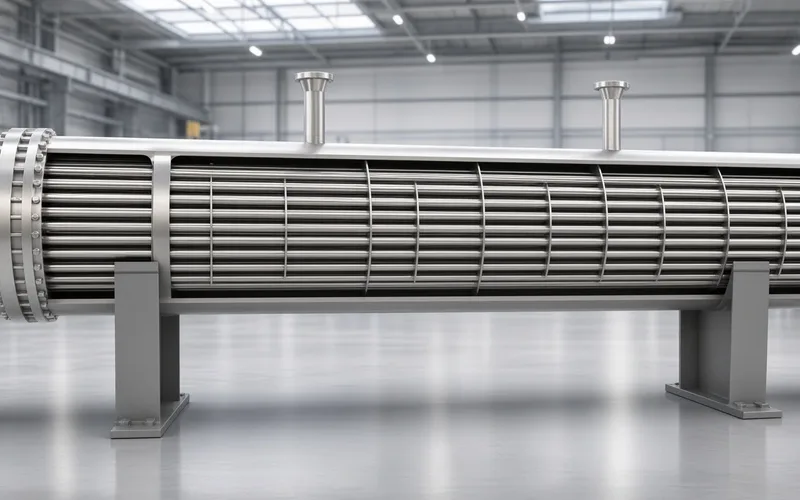
Straight Tube
Fixed tubesheets, every bore open end to end: the construction to choose when you must see inside.
+ Learn More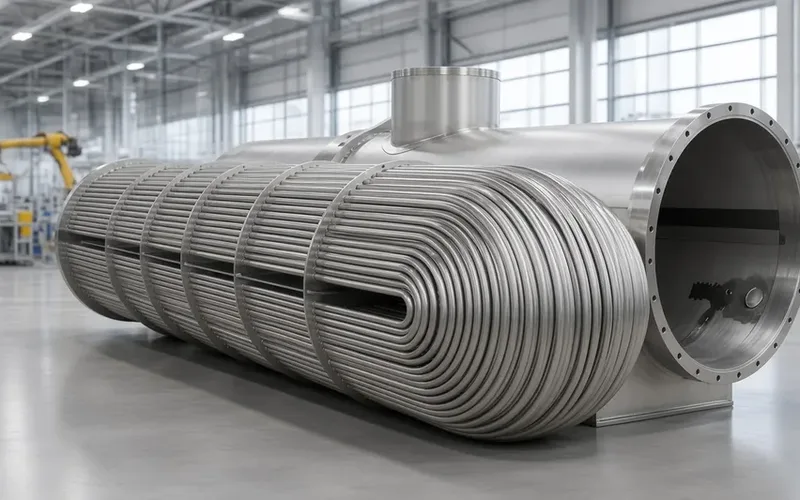
Sanitary Exchangers
U-Tube
One tubesheet, a bundle that grows on its own, and a shell that never sees an expansion joint.
+ Learn More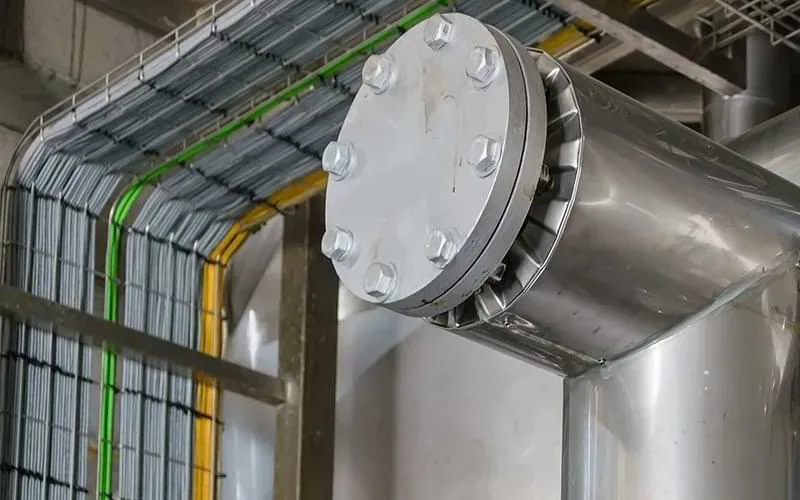
Sanitary Exchangers
Shell & Tube
Straight tube, U-tube and double tubesheet bundles built for steam, pressure and a clean CIP return.
+ Learn More