
1-805-484-2992
Quotes - Engineering - SalesHigh-acid juice, pH below 4.6
Enzymes set the temperature, not microbes
At a pH under 4.6 the organisms that survive in juice are yeasts, molds and lactic bacteria, and 185 F for a few seconds kills all of them. The pasteurizer runs hotter and longer than that because of pectin methylesterase, the enzyme that strips cloud out of citrus and thins a nectar in the bottle. Inactivating it takes 195 F for 30 seconds in orange juice, and that pair is what most juice pasteurizers are cut for.
This page covers the heating section, the hold and the pulp question; cooling and filling have their own page.
Building the pasteurizer for the juice that is actually in the tank
Where the temperature comes from
Not-from-concentrate orange juice is the hardest case in the section. Cloud stability depends on inactivating pectin methylesterase, which is more heat-resistant than any spoilage organism in the juice, and the accepted pair is 195 F for 30 seconds, with some processors holding to 200 F. Apple, grape and cranberry have no cloud to protect and pasteurize at 185 F for 15 seconds. Tropical nectars with pulp sit between: 190 F for 20 to 30 seconds, sized for the fiber.
The other route is the hot break, used on tomato and on some berry and stone fruit before pressing. The mash is flashed to 200 to 210 F within a minute of crushing so the pectinase never gets started, and the juice keeps its body. That is a tubular heater or steam injection ahead of the press, not the finished-juice pasteurizer.
Clear juice on plates
Filtered apple, white grape and clarified citrus are water-thin and run a three-section gasketed plate pasteurizer the same way fluid milk does: regenerator, heater, hold, then the cooler. Regeneration recovers 85 to 90 percent and the hot water heater closes the last 15 to 25 degrees.
The heater approach is the number to watch. Apple juice at 12 Brix has enough fructose to caramelize on a wall above 205 F, and the film sets up in an afternoon if the hot water runs 20 degrees over the product. HeatX sets hot water at 5 to 8 degrees above the pasteurization temperature and gets the duty from area, not driving force.
Pulp, cells and fiber in tubes
Orange juice with 6 to 12 percent pulp, mango, guava, passion fruit and vegetable juice do not belong on a plate. Pulp collects at the inlet ports and gasket corners, the pressure drop climbs across the shift, and the operator ends up opening the frame at lunch. A corrugated tube-in-tube with a 1 to 1-1/2 inch product bore passes the pulp, keeps the coefficient within 20 percent of a plate through the corrugation, and holds velocity at 3 to 5 ft/s so nothing settles.
Regeneration in tubes is product against product in a tube-in-tube-in-tube or through a water loop, and it recovers 60 to 75 percent rather than 90.
The hold and the common mistake
Pulpy juice at 195 F runs in laminar or transitional flow in the holding tube, and the fastest pulp particle can travel at twice the mean velocity. A tube cut for 30 seconds on the mean gives 15 seconds at the fastest particle, and the plant's cloud fails in the warehouse three weeks later with nothing on the chart to explain it. The tube is cut on the fastest particle and validated with a conductivity pulse at the line's running flow.
The mistake is buying a pasteurizer for today's clear juice and adding a pulp SKU next season. The plates block, the hold is wrong and the plant is back to square one. Tell us every juice the line might run. Call and talk it through with an engineer: 1-805-484-2992




Juice pasteurization process conditions
These are the figures a juice pasteurizer is quoted against, from pulp and acidity to the hold and the cleaning cycle. Measure your own juice against them and send the differences with your request.
| Condition | Detail |
| Product | Citrus, apple, grape, berry, tropical nectar; 8 to 18 Brix, pH 2.8 to 4.2, pulp 0 to 12 percent |
| Flow range | 20 to 600 gpm |
| Temperatures in / out | 40 to 60 F in from deaeration; 185 to 195 F at the hold; back to the cooler or filler |
| Hold | 15 to 30 seconds; 30 seconds at 195 F for citrus enzyme inactivation |
| Utility | Hot water at 195 to 205 F from a steam-to-water set |
| Approach | 5 to 8 degrees on the heater; 10 degrees on the regenerator terminal |
| Construction | Gasketed plate for clear juice; corrugated tube-in-tube or wide-gap plate for pulp |
| Finish / class | 316L product side, 32 Ra; 3-A or food-grade drainable |
| CIP | Caustic 1.5 percent at 170 F, acid for pectin and scale, once per shift |
Common FAQs
For microbial kill, yes. For cloud stability, no: pectin methylesterase in citrus needs about 195 F for 30 seconds. Clarified citrus and other juices without cloud pasteurize at 185 F for 15 seconds.
Only if it is built for the pulpy one. A corrugated tube-in-tube runs clear juice at slightly lower regeneration; a plate pack built for clear juice blocks on pulp.
It is a fast heat to 200 to 210 F on freshly crushed tomato or fruit mash to kill pectinase before pressing. It is a tubular heater or steam injection ahead of the press, separate from the finished-juice pasteurizer.
Sugar and pectin caramelize on a wall above about 205 F. A 5 to 8 degree hot water approach, 3 ft/s in tubes and an acid CIP step keep it to once a shift.
Related
Applications
Hot Fill & Cooling
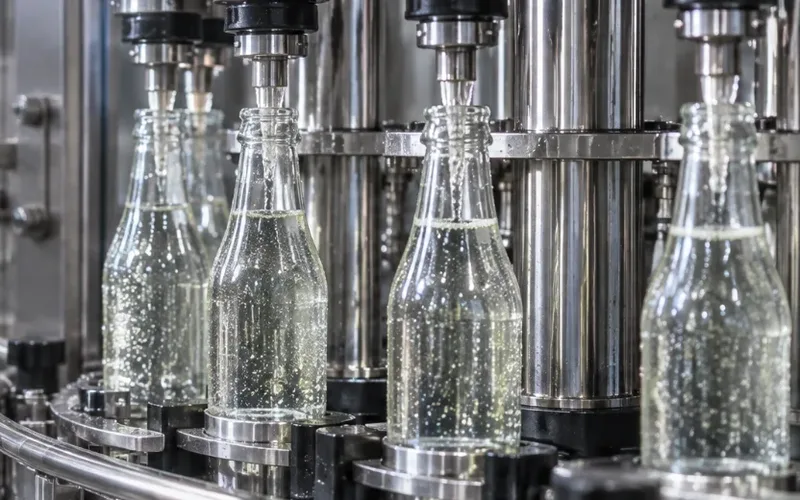
The cooler is either a small trim section for hot fill or the biggest exchanger on the line for cold fill.
+ Learn More
Applications
Soft Drinks & Water
Syrup at 65 Brix, product chilled to 36 F for CO2, water deaerated at 110 F, all on one plant floor.
+ Learn More
Applications
Coffee & Tea Extracts
Hot water for extraction, fast cooling of the extract, and pasteurizers for ready-to-drink tea and coffee.
+ Learn More