
1-805-484-2992
Quotes - Engineering - SalesFormulated egg products
The recipe decides the exchanger
Scrambled egg mix for food service, omelet blends, egg patty mix, custard and quiche bases, and the egg-and-milk blends that go to bakeries are whole egg with something added: skim milk or cream at 10 to 30 percent, modified starch at 1 to 3 percent, salt, cheese, vegetable pieces, or citric acid to hold color. Each addition changes the viscosity, the pasteurization temperature and the fouling, and the exchanger is sized for the recipe.
This page is about those blends: the temperature each requires, the tubes that carry a 300 cP product with pieces in it, and validation across recipes.
Blends, their temperatures and the tubes they need
What the additives do to the process
Whole egg pasteurizes at 140 F. Add 2 percent salt, 10 percent milk or a few percent sugar and the proteins are protected enough that the same kill needs a higher temperature, and the plant's process authority sets a schedule of 142 to 145 F for 3.5 minutes per recipe. Add starch and the product thickens on heating rather than thinning, so a blend that pumps at 100 cP cold may be 300 cP in the hold.
Each recipe therefore has its own setpoint, its own hot water temperature, and its own holding tube validation. The exchanger is built for the recipe with the highest viscosity and the tightest approach, and the others run with margin.
Tubes for a thick blend with pieces
A smooth scrambled egg mix at 150 to 300 cP runs in a single tube-in-tube with a 1-1/2 to 2 inch bore at 1.5 to 2.5 ft/s, hot water in the annulus, in enough passes to reach 142 F on a 3 to 4 degree approach. The heater is long because the flow is laminar and a corrugated tube cannot be used on a product with cheese in it. Omelet blends with dice to 1/4 inch step the bore up to 2 or 3 inches.
Above about 10,000 lb/h a multi-tube with seven 1-1/2 inch tubes replaces the single tube on smooth blends, at a better coefficient and a shorter frame. Both have jacketed return bends so the blend never meets an unheated surface where it would thicken and set.
Cooling a blend, and blends that go hot
Most blends are cooled to 40 F for bag or tote, and the cooler is sized on the cold-end viscosity, which for a starch-thickened mix at 40 F can be 500 cP or more. Chilled water then glycol at a 10 to 12 degree approach, and the last pass bored up rather than the pump speeded up. A blend with cream separates if the cooler is too aggressive at the inlet, so chilled water comes first and glycol last.
Some blends go straight from the hold to a cook line: egg patties and folded omelets are cooked continuously at 180 to 200 F on a belt or in molds, and the pasteurizer's outlet is a heater to 160 to 170 F rather than a cooler. The second heater runs on hot water at a 15 to 20 degree approach because the product is about to be cooked anyway.
The common mistake
Validating the holding tube on whole egg and running every blend through it. A starch blend at 300 cP in the hold is fully laminar, the fastest particle runs at twice the mean, and the 3.5 minutes the whole egg met becomes 1.8 minutes on the blend. Every recipe is validated at its own viscosity and flow. Send the recipes, their viscosities cold and at the hold, the largest piece, the flow, and where the product goes after the hold. Call and talk it through with an engineer: 1-805-484-2992


Egg mix and blend process conditions
Egg mixes foul and thicken quickly when heated, so these rows set the limits we design inside. Set them next to your blend and send the recipe, the flow and the temperatures you need for the quote.
| Condition | Detail |
| Product | Whole egg with milk, cream, starch, salt, cheese, seasoning or vegetables; 100 to 300 cP; pieces to 1/4 inch on omelet blends |
| Flow range | 1,000 to 15,000 lb/h |
| Temperatures in / out | 40 F in; 140 to 145 F at the hold by recipe; 40 F out, or 180 F to a cook line |
| Hold | 3.5 minutes at the validated temperature for each recipe |
| Utility | Hot water at setpoint plus 3 to 4 degrees; chilled water then glycol on the cooler |
| Approach | 3 to 4 degrees on the heater; 10 to 12 degrees on glycol |
| Construction | Single tube-in-tube, 1-1/2 to 2 inch bore for smooth blends; 2 to 3 inch for blends with pieces; multi-tube where flow is high |
| Finish / class | 316L, 32 Ra; 3-A; removable inner tube for inspection |
| CIP | Caustic at 165 F, acid for milk minerals, sanitizer; 6 hours between cleanings on dairy blends |
Common FAQs
Salt, sugar and milk solids protect the proteins, so the same microbial kill takes a higher temperature. The process authority sets 142 to 145 F for 3.5 minutes per recipe; whole egg alone is 140 F.
Yes, in a plain single tube-in-tube with a 2 to 3 inch bore at low velocity and jacketed bends. Corrugated tubes are not used on cheese blends because fat separates and collects in the corrugations.
It makes the product thicken on heating, so the heater is sized on the hold viscosity rather than the pumping viscosity, and the holding tube is validated at that viscosity because the fastest-particle ratio rises.
Yes, if the exchanger is built for the thickest blend and the tightest approach on the schedule, and each recipe has its own hot water setpoint and holding tube validation. HeatX sizes it from the recipe list.
Related
Applications
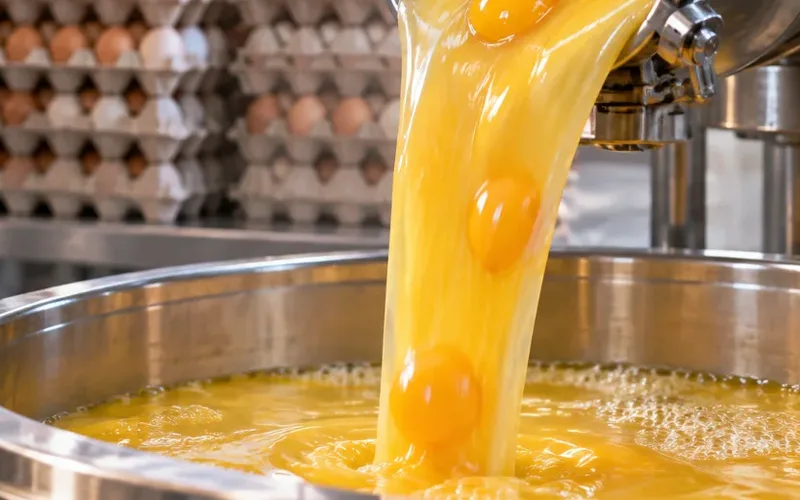
Whole Egg Pasteurization
140 F for 3.5 minutes, with a hot water approach small enough that nothing sets on the wall.
+ Learn More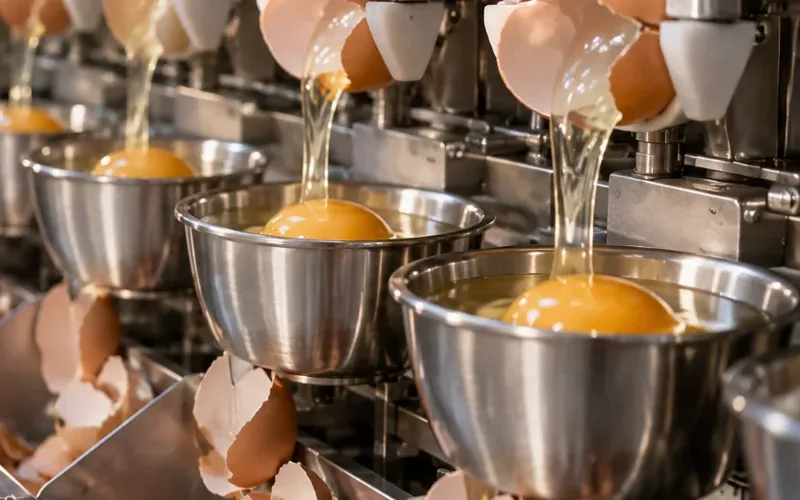
Applications
Egg White & Yolk
The thinnest and the thickest egg products, each with its own temperature and its own exchanger.
+ Learn More
Applications
Egg Product Cooling
The section after the hold, where the egg has to get out of the growth range and down to 40 F in minutes.
+ Learn More