
1-805-484-2992
Quotes - Engineering - SalesFruit and vegetable purees, infant food, applesauce
No pieces, so the tube can do its best work
A smooth puree is the one product in the sauce family that lets the exchanger run at its full coefficient. With nothing larger than a fiber in the flow, the inner tube can be corrugated, the velocity can rise to 3 to 5 ft/s, and the heater is half the length it would be for a chunky sauce at the same duty. The trade-off is that purees are thick, 500 to 5,000 cP, and many of them, the vegetable and meat-based infant foods, are low-acid products that have to be sterilized, not pasteurized.
The two branches are high-acid fruit purees and applesauce at 190 to 200 F with a short hold, and low-acid vegetable, meat and mixed baby foods at 250 to 265 F for aseptic filling into pouches or jars.
High-acid purees, low-acid baby food and the exchangers each needs
High-acid fruit purees and applesauce
Applesauce, pear, banana and berry purees at pH below 4.0 are pasteurized at 190 to 200 F for 30 to 60 seconds, hot filled at 185 F into jars and pouches or cooled for aseptic bag-in-box. The heater is a corrugated tube-in-tube or a multi-tube of 1 to 1-1/2 inch corrugated tubes, on hot water at 215 to 230 F, and it runs at 3 to 5 ft/s because there is nothing in the puree to shear.
Regeneration on a puree goes through a water loop and recovers 50 to 60 percent. The cooler on a chilled or aseptic line is sized on the cold-end viscosity, which for a 12 Brix apple puree doubles between 195 and 90 F, and the glycol or chilled water approach is held to 15 degrees.
Low-acid baby food: sterilize, then fill aseptically
Carrot, pea, squash, chicken and mixed infant purees are pH 5 to 6.5 and are low-acid foods: they are sterilized, not pasteurized, and the process is filed with a process authority. In a continuous line the puree is heated to 250 to 265 F in a tubular sterilizer under 40 to 60 psi back pressure so it cannot boil, held in an insulated tube for the scheduled time, typically 30 to 120 seconds to deliver the required F0, cooled to 80 to 90 F, and filled aseptically.
The heater on a sterilizer runs on pressurized hot water at 275 to 290 F or on 60 to 100 psig steam through a water loop, with a 25 to 35 degree approach that is chosen for wall temperature rather than area. Vegetable purees brown on a wall above 300 F, and a baby food with a cooked flavor fails sensory first.
What infant product changes about the hardware
Baby food processors ask for more than a standard food-grade specification. Product contact surfaces are polished to 20 Ra and often electropolished; the only gaskets in the product path are tri-clamp seals in FDA-listed elastomers; every product-contact weld is orbital and documented.
316L is universal on infant product, and HeatX supplies mill certs and a passivation record with every unit.
The common mistake
Sizing the sterilizer hold for the mean residence time. A 2,000 cP puree in a 1-1/2 inch tube is in laminar flow, the centerline runs at nearly twice the mean velocity, and the F0 at the fastest particle is roughly half the calculated value. The hold tube is sized on the fastest particle with a residence time test the process authority accepts. Send the product list, pH, viscosity at fill and process temperature, the scheduled process and the filler type. Call and talk it through with an engineer: 1-805-484-2992




Puree and baby food process conditions
These are the conditions a smooth puree line is sized to, split between high-acid and low-acid duty. Match your product to the right row set and send your fill method with the quote request.
| Condition | Detail |
| Product | Fruit, vegetable, meat and mixed purees; 8 to 25 Brix; 500 to 5,000 cP; no pieces |
| Flow range | 5 to 100 gpm |
| Temperatures in / out | High-acid: 70 F to 190 to 200 F, cooled to 90 F or 40 F. Low-acid: 70 F to 250 to 265 F, cooled to 80 to 90 F for aseptic fill |
| Hold | High-acid 30 to 60 seconds; low-acid 30 to 120 seconds at 250 to 265 F per the scheduled process |
| Utility | Hot water 215 to 230 F on high-acid; pressurized water at 275 to 290 F on sterilizers |
| Approach | 20 to 30 degrees; sterilizers 25 to 35 degrees under 40 to 60 psi back pressure |
| Construction | Corrugated tube-in-tube or multi-tube, 1 to 1-1/2 inch bore; regeneration through a water loop |
| Finish / class | 316L, 20 to 32 Ra product side; 3-A and aseptic design with steam barriers on sterilizers |
| CIP | Caustic 1.5 percent at 170 F, acid for pectin and mineral; SIP at 250 F before every aseptic run |
Common FAQs
Sterilized. At pH 5 to 6.5 it is a low-acid food and needs a scheduled process at 250 to 265 F, filed with a process authority, delivered in a pressurized tubular sterilizer and hold followed by aseptic filling.
Because there are no pieces to damage. Corrugation raises the coefficient 30 to 50 percent on a viscous laminar flow and cuts the heater length; on a chunky sauce it would shear the pieces.
20 Ra or better on product contact, frequently electropolished, with orbital welds, documented elastomers and mill certificates for the 316L. HeatX builds to that specification and ships the paperwork with the unit.
Enough to keep the puree from boiling at 265 F, which is about 25 psi above atmospheric, plus a margin: 40 to 60 psi at the back pressure valve after the cooler is typical.
Related
Applications
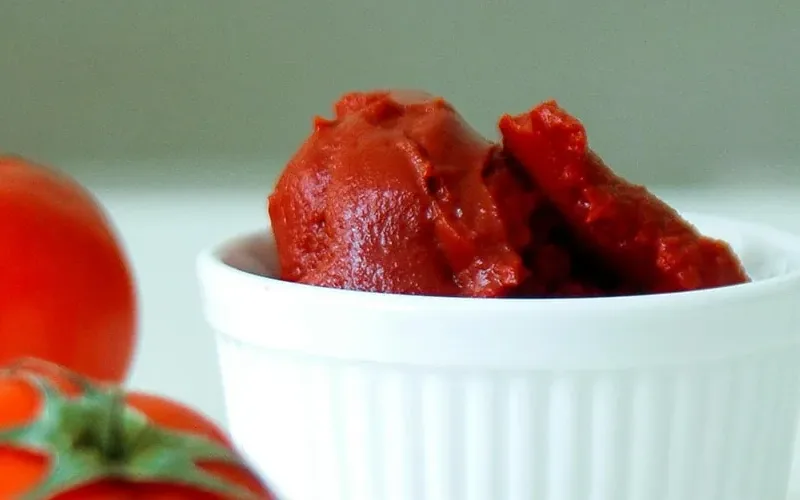
Tomato Sauce & Paste
From hot break at the crusher to a cooled sauce in the tote, without browning the product on the wall.
+ Learn More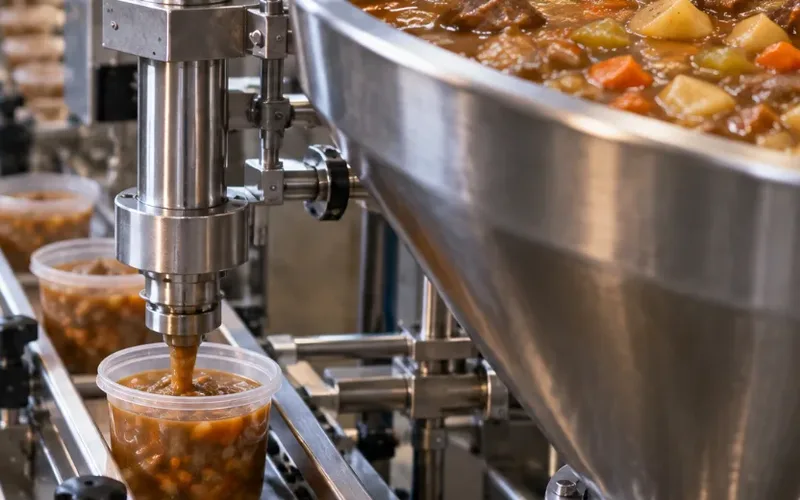
Applications
Soups & Stews
A thin broth carrying pieces to 1/2 inch, where the piece sets the bore and the hold.
+ Learn More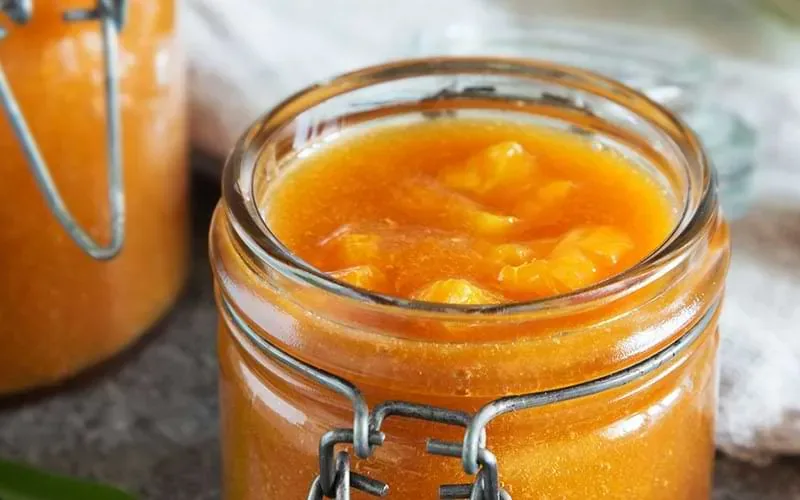
Applications
Fruit Preparations & Jams
High sugar, high viscosity, delicate fruit pieces and a wall that burns on if the approach is wrong.
+ Learn More