
1-805-484-2992
Quotes - Engineering - SalesResistivity is the spec
The exchanger is judged by what it does not add to the water
Deionization passes water through cation and anion exchange resins that swap sodium, calcium, iron and copper for hydrogen, and chloride, sulfate and bicarbonate for hydroxide, leaving water whose resistivity is read in megohm-centimeters. A mixed bed with polishing reaches 18.2 megohm, which is 0.055 microsiemens and the theoretical limit. That water will restore its equilibrium by dissolving whatever it flows over, and an exchanger is a long narrow pipe with a lot of surface.
The parent page explains pitting in low-conductivity water. What a DI loop adds is leaching: metal that goes into solution with no visible attack and shows up as falling resistivity at the loop return and as copper on a wafer. This page is about that, resin temperature limits and loop velocity.
Building a heat exchanger for deionized water
Leaching and the metals that must stay out
Copper is the first thing a DI loop finds. A copper-brazed plate, a bronze valve body or a brass gauge fitting puts copper into 18 megohm water within hours, and copper on a wafer or in a cell culture is a ruined run. Nickel-brazed plates are better and still not right: the braze is unpassivated and its edges are crevices. The rule is stainless or better everywhere the water touches: 316L tubes, tubesheets and heads, electropolished and passivated, or titanium where the site's metals specification excludes stainless.
Elastomers leach too. Nitrile gives up plasticizers and silicone gives up siloxanes into low-TOC water. HeatX uses EPDM or PTFE-encapsulated gaskets on the utility side only and no gasket at all in the DI path on a straight-tube unit.
Resin temperature limits and where the heater goes
Hot DI water for parts cleaning or hot rinse is heated after the resin beds, never before, because anion resin loses capacity and sheds amines above about 140 F while cation resin tolerates 250 F. The heater sits on the loop supply downstream of the mixed bed and the final filter; the return to the tank goes through a cooler so the bed never sees hot water. On a loop with a UV sterilizer, the heater sits after the UV as well, because the lamp's transmittance is rated at ambient.
- Heater after the mixed bed and final filter, cooler on the return
- Hot water utility on the heater; steam only through a hot water loop to keep the wall below 200 F
- High-limit switch on the DI outlet set 10 degrees above setpoint
Velocity, stagnation and the loop cooler
A DI loop is kept moving at 3 to 5 ft/s so a biofilm cannot establish. The exchanger is part of that loop: tubes sized for that velocity, no shell-side pockets, and a low-point drain so the unit empties for hot water or peroxide sanitization. The loop cooler removes pump heat, roughly 2,500 Btu/h per horsepower; on a 200 gpm loop with a 20 hp pump that is a 50,000 Btu/h cooler holding 72 F on 45 F chilled water.
Shell diameters run from 2 in for a lab loop to 48 in and 65 ft long for electronics rinse trains, in straight tube, U-tube, multi-pass and double tubesheet forms.
The common mistake
A copper-brazed plate bought as a loop cooler because it is compact and cheap. Resistivity at the return drops from 18 to 15 megohm within a week, the mixed bed is blamed and changed, and the number keeps falling because the copper source is downstream of the bed. A 316L straight-tube cooler costs more on the day and is the last time anyone thinks about it. Call and talk it through with an engineer: 1-805-484-2992



DI water process conditions
Resistivity, velocity and wetted materials are all fixed in the rows, since deionized water attacks whatever it touches. Compare your loop requirements and send them with your quote request.
| Condition | Detail |
| Fluid | Deionized water, 1 to 18.2 megohm; TOC under 50 ppb on semiconductor and lab loops |
| Flow range | 5 to 100 gpm laboratory and pharma loops; 100 to 1,500 gpm semiconductor and electronics rinse |
| Temperatures in / out | Loop held 68 to 77 F; hot DI at 140 to 160 F for parts cleaning; cold DI at 40 to 50 F for rinse |
| Hold | None; return to the storage tank |
| Utility | Chilled water or glycol on coolers; hot water or steam through a hot water loop on heaters |
| Approach | 5 to 8 degrees on chilled water; 10 on hot water |
| Construction | Straight tube in 316L, DI water in the tubes; double tubesheet where the utility is tower water or plant steam; titanium tubes where the metals spec excludes stainless |
| Finish / class | 316L, 15 to 20 Ra electropolished and passivated; polymer-lined or PVDF-shell options where required |
| Velocity | 3 to 5 ft/s in the tubes, loop never stagnant |
| CIP / SIP | Hot water sanitization at 176 F, hydrogen peroxide or ozone on schedule; gaskets rated for the sanitizer |
Common FAQs
Pure water is far from equilibrium with every metal, so it dissolves ions from the surface until it is not. There is no corrosion product to see; the evidence is resistivity falling along the loop and metal showing up in the analysis.
Not copper-brazed. Nickel-brazed units appear on non-critical loops, but the braze is a crevice. A welded 316L straight tube or a gasketed 316L plate with EPDM is the standard.
On semiconductor, pharmaceutical and analytical loops, yes: 15 to 20 Ra electropolished and passivated. On a general laboratory or electronics loop 32 Ra mechanically polished and passivated is normal.
Through a hot water loop, or with a steam heater whose wall is kept below 200 F by a low steam pressure and a modulating valve. Direct high-pressure steam on 316L tubes in DI water invites pitting at the hot end.
Related
Applications
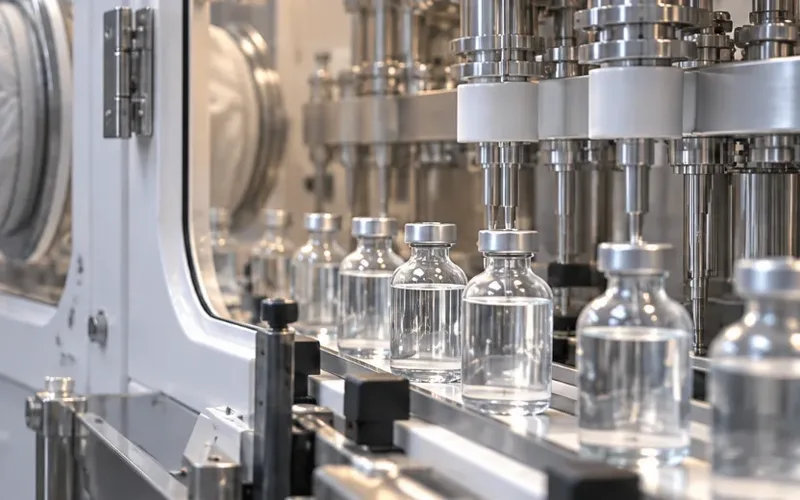
Sterile Water
Cooling and heating water that has to stay sterile after the still, from the hot loop to the last valve.
+ Learn More
Applications
RO Water
Feed heaters that respect the membrane limit, and permeate exchangers for water that is acidic and empty.
+ Learn More
Applications
Demineralized Water
Heating makeup for the boiler, cooling water for the resin, and cooling the regeneration waste for the drain.
+ Learn More