
1-805-484-2992
Quotes - Engineering - SalesFluid milk, Grade A
Two time-temperature pairs, one rulebook
The Pasteurized Milk Ordinance lists the legal minimums for fluid milk as a table of equivalent time-temperature pairs. The two that plants build around are 161 F for 15 seconds, continuous HTST, and 145 F for 30 minutes, batch vat pasteurization. Whichever pair the plant picks, the exchanger has to prove that the coolest particle of milk met it.
This page is the milk-specific part of that job: what raw milk does on the way to 161 F, how vat and continuous differ, and what an inspector asks you to demonstrate. Regeneration, holding tubes and flow diversion have their own pages.
What the milk does, and what the hardware has to do about it
What raw milk does on the way to 161 F
Raw milk arrives at 38 to 45 F with its fat in globules, its casein in micelles and its whey protein folded, and nothing happens to any of that below 140 F. Between 140 and 161 F beta-lactoglobulin unfolds and a little calcium phosphate drops out, which is why the heating section fouls while the regenerator does not. At 161 F for 15 seconds alkaline phosphatase is destroyed, and that is the lab test on every load: a positive phosphatase means the milk did not see the pair, whatever the chart says.
Regeneration lifts the milk to about 148 F; hot water adds the last 13 degrees, and that lift is where wall temperature matters. Hot water at 166 F gives a 5 degree approach and a clean shift; at 180 F it bakes a protein film onto the plates by mid-morning.
Vat pasteurization: 145 F for 30 minutes
A vat pasteurizer is a jacketed, agitated tank. Milk is heated to 145 F, held 30 minutes with the airspace above it at least 5 degrees warmer, then cooled in the vat or through an outlet cooler. The exchanger is the jacket, hot water or low-pressure steam outside, milk inside, with an agitator that keeps the batch within 1 degree.
The vat wins for small dairies and lots under a few thousand gallons. Its weak point is cool-down: a 2,000 gallon vat on tower water takes over an hour from 145 F to 45 F and loses shelf life the whole time. The fix is a plate or tube cooler on the outlet sized to empty the vat in 20 to 30 minutes on chilled water, about 900,000 Btu/h.
- Airspace heater 5 degrees above the milk
- Leak-protect valves during the hold
- Outlet cooler empties the vat in 20 to 30 minutes
Continuous HTST: what is specific to milk
On fluid milk the plate pasteurizer is the default. Milk at 2 cP runs a 3 mm channel at 1.5 to 2 ft/s with a film coefficient near 2,000 Btu/h-ft2-F, so three sections fit one frame and the regenerator recovers 90 percent. Skim through whole milk are one fluid on one set of plates.
The milk-specific decisions are the cooling target and the homogenizer position. Cooling to 38 F rather than 40 F costs about 15 percent more chilled water plates and buys days of shelf life. The homogenizer sits between the regenerator outlet and the heating section, so the pressure drop on both sides of it must be known. The same continuous layout applied across a whole dairy product list is laid out on our dairy pasteurization pages.
The common mistake
Sizing the pasteurizer for today's flow and the timing pump for next year's. The holding tube is cut for one flow; raise the pump 20 percent and the hold drops from 15 to 12.5 seconds, the recorder still reads 161 F, and the milk is legally unpasteurized. HeatX sizes the sections and cuts the tube for the future flow and derates the pump now, so the upgrade is a re-sealed setpoint, not a re-inspection.
Send the product list, the flow now and later, raw inlet and required outlet temperature, and the utilities available. Call and talk it through with an engineer: 1-805-484-2992




Milk pasteurization process conditions
Vat and continuous plants are laid out side by side here, from product and hold to utility, finish and records. Set your own flows and temperatures against them and send the gaps with your quote request.
| Condition | Detail |
| Product | Raw whole, 2 percent, 1 percent or skim milk; 8.5 to 13 percent solids |
| Flow range | Vat 200 to 3,000 gallons per batch; HTST 5,000 to 100,000 lb/h |
| Temperatures in / out | 40 F raw in; 161 F at the hold; 38 to 40 F out |
| Hold | 15 seconds at 161 F (HTST) or 30 minutes at 145 F (vat) |
| Utility | Hot water at 164 to 168 F; vat jacket on hot water or low-pressure steam |
| Approach | 3 to 5 degrees on the heating section |
| Construction | Three-section gasketed plate; tubular for high fat or fiber; jacketed agitated vat |
| Finish / class | 3-A, 316L product side, 32 Ra, EPDM gaskets |
| CIP | Caustic and acid at 165 to 180 F once per shift |
| Records | Safety thermal limit recorder chart, indicating thermometer |
Common FAQs
Above about 3,000 gallons a day HTST is cheaper to run and keeps shelf life better because the milk is hot for seconds, not an hour. Below that, a vat with a good outlet cooler is simpler.
No. Milk with added sweetener, or 10 percent or more fat, goes to 166 F for 15 seconds; with both, 175 F. Vat products with those additions go to 150 F.
Alkaline phosphatase is inactivated at very nearly the pair that kills the target organisms, so a negative test proves every particle met it. A chart proves only that the sensor did.
Yes. A replacement regenerator, heating section or cooler is sized to the existing timing pump, holding tube and frame, with 3-A plates and gaskets. Send the frame make, plate counts and utilities.
Related
Applications
Regeneration Sections
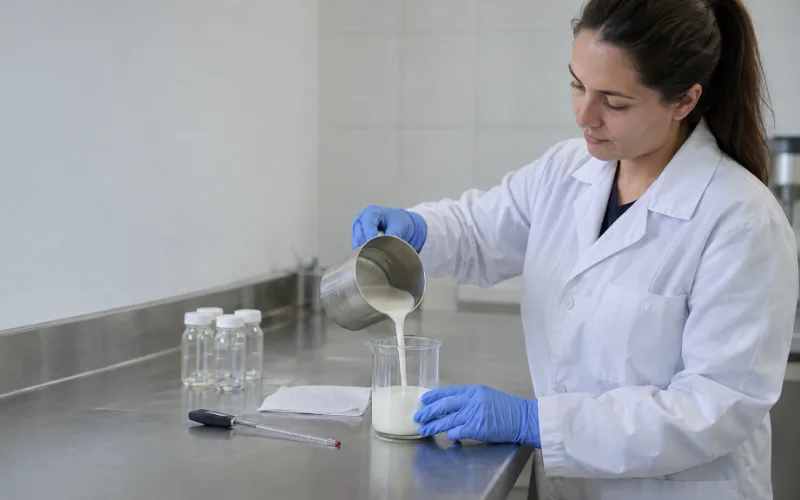
Raw milk heated by pasteurized milk through a plate, 85 to 95 percent, pressure always pointing the safe way.
+ Learn More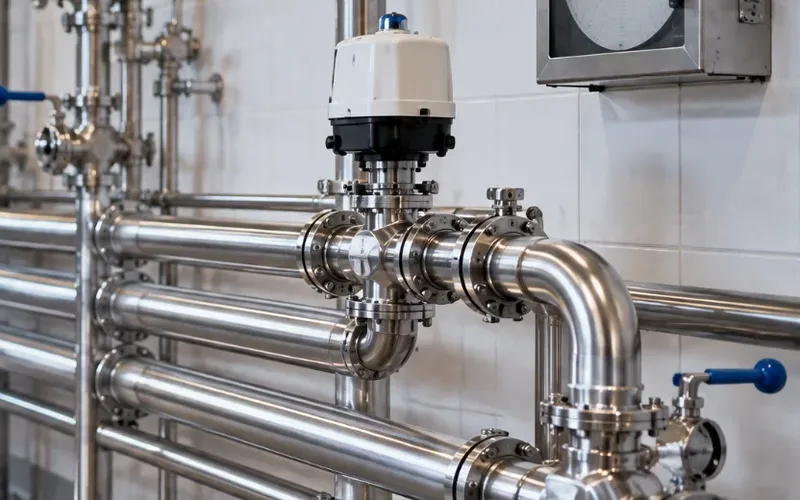
Applications
Holding Tubes & Flow Diversion
Tube length from velocity and hold time, a valve that diverts in under a second, and a chart that proves both.
+ Learn More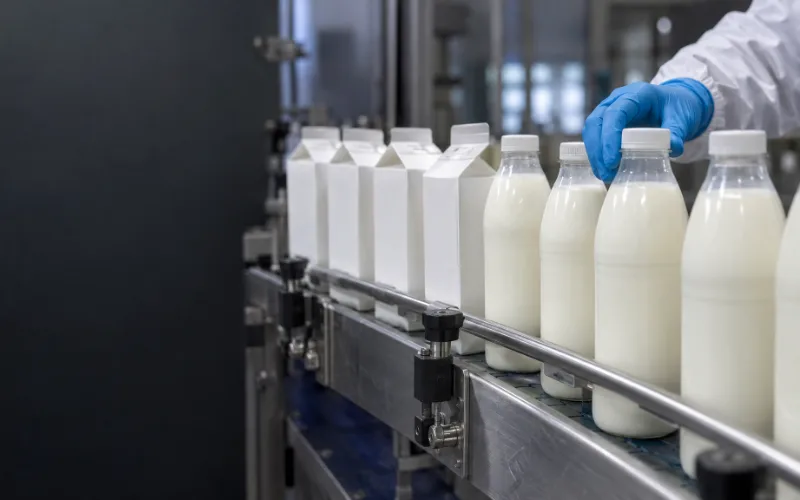
Applications
Plate vs Tubular HTST
Plates for thin milk and short payback; tubes for viscosity, fiber, fouling and 20-hour runs.
+ Learn More