
1-805-484-2992
Quotes - Engineering - SalesCheese plant and membrane streams
Nine pounds of whey for every pound of cheese
A cheese plant makes far more whey than cheese, and every pound goes through at least two heat exchangers: one to cool it off the vat so it does not sour or scale, and one to warm it back up for separation, membrane filtration or the evaporator. Ultrafiltration splits it again into a protein concentrate and a permeate of lactose and minerals, with its own exchangers on the way to crystallization or RO.
The fluids are thin, the flows are large, and they all scale. This page follows the whey through the plant, exchanger by exchanger.
The whey exchangers in the order the whey meets them
Vat whey cooling
Whey drains from the vat at 95 to 105 F in a surge that can be 800 gpm for ten minutes and nothing for an hour, carrying curd fines. The cooler takes it to 40 F for storage or 50 to 55 F for cold ultrafiltration, on the surge or from a whey balance tank that lets a smaller cooler run steadily. Most plants use the tank.
Fines are the design question. A clarifier ahead of the cooler lets a standard 3 mm plate gap be used; without one, the cooler is wide-gap plate or corrugated tube with a bore that passes 3 mm curd. Cooling promptly matters too: every minute above 90 F the lactic bacteria work and the calcium phosphate moves closer to precipitating.
Membrane feed and permeate
Ultrafiltration runs whey cold at 50 to 55 F or warm at 120 to 125 F. Warm UF needs a feed heater on hot water; cold UF needs a small cooler on the recirculation to remove pump heat, about 150,000 Btu/h at 300 gpm through a skid at 60 psi. Both are small, clean duties on clarified whey, and gasketed plates are the answer.
Permeate leaving the UF is clear, 5 to 6 percent solids, mostly lactose and minerals. It scales worse than whey because the protein that would coat the wall is gone and the minerals hit bare stainless; a permeate heater to 160 F needs acid CIP every cycle and an approach under 8 degrees. The concentrate side of the membrane plant is covered on our whey protein concentrate page.
- Warm UF feed heater: 40 F to 122 F on hot water, plate
- Cold UF loop cooler: 150,000 to 300,000 Btu/h of pump heat
Evaporator feed preheating
Whey or permeate going to a falling film evaporator is preheated to the first effect temperature, 160 to 180 F, and that preheater scales fastest of anything in the plant: highest mineral load, hot wall, 20 hours a day. Its approach is set by the evaporator condensate or vapor that feeds it, so its defense is to be brushable: straight tube with removable heads, whey in the tubes at 5 ft/s, rodded between daily acid CIPs.
Two or three stages on successively hotter condensate spread the scale over several units. Acid whey preheaters are 316L without discussion; at 170 F and pH 4.5 acid whey pits 304 in a season, starting at the tube welds.
The common mistake
Running whey on the milk exchanger's CIP program. Milk fouling is protein and responds to caustic; whey fouling is calcium phosphate under a thin protein film, and caustic cleans the film and leaves the scale. After a week the whey cooler has lost a third of its capacity and the plant adds caustic time. The acid step is not optional: nitric or phosphoric at 1 to 2 percent, 140 to 150 F, every cycle.
Send the whey type and pH, whether fines are removed, the flow pattern from the vats, the temperatures at each duty and the CIP chemistry the plant runs. Call and talk it through with an engineer: 1-805-484-2992


Whey and permeate process conditions
These rows cover whey from the vat through the membrane plant to the evaporator, including fines, pH and the acid step in cleaning. Match them to your streams and send the differences along with the quote request.
| Condition | Detail |
| Product | Sweet whey pH 6.2 to 6.4; acid whey pH 4.4 to 4.6; UF permeate 5 to 6 percent solids |
| Flow range | Vat whey 50 to 800 gpm in surges; membrane streams 100 to 500 gpm continuous |
| Temperatures in / out | Vat 100 F to 40 F; membrane feed to 55 F or 122 F; evaporator feed to 160 to 180 F |
| Hold | Pasteurization of whey for WPC: 161 F for 15 seconds |
| Utility | Tower and chilled water; hot water for membrane feed; condensate for preheat |
| Approach | 5 to 8 degrees; kept wide on the hot side to limit scaling |
| Fines | Curd fines 0.5 to 3 mm; clarified or passed through a wide channel |
| Construction | Wide-gap plate or corrugated tube on vat whey; plate on clarified streams; brushable straight tube on preheat |
| Finish / class | 3-A; 316L on acid whey and above 140 F |
| CIP | Caustic then acid every cycle, acid step sized for calcium phosphate |
Common FAQs
Sweet whey from rennet cheese is pH 6.2 to 6.4 and runs on 304L when cold. Acid whey from cottage cheese and Greek yogurt is pH 4.4 to 4.6, corrosive to 304 at temperature, and is 316L at every duty.
If the cooler is a standard plate unit, yes; curd fines lodge in a 3 mm gap. Without one, use a wide-gap plate or a corrugated tube with a bore over 12 mm.
Whey protein coats the wall first and the minerals deposit on that soft film, which caustic removes. Permeate has no protein, so calcium phosphate crystallizes directly on the stainless as hard scale.
40 F for storage, 50 to 55 F straight to cold UF, or 120 to 125 F to warm UF within the hour. Whatever the target, get it below 90 F within minutes.
Related
Applications
Raw Milk Cooling
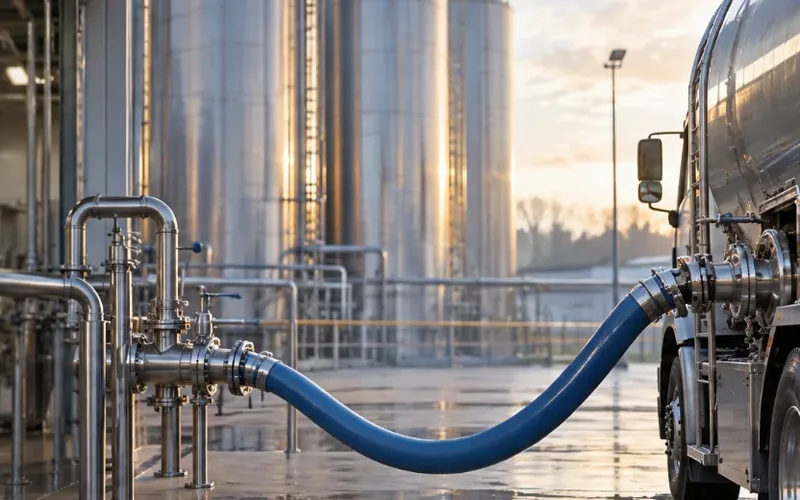
Receiving bay and farm coolers on well and chilled water, sized for the August tanker and the two-hour rule.
+ Learn More
Applications
Cream Heating & Cooling
Half and half to heavy cream, heated to 166 F and cooled to 40 F without churning, feathering or channeling.
+ Learn More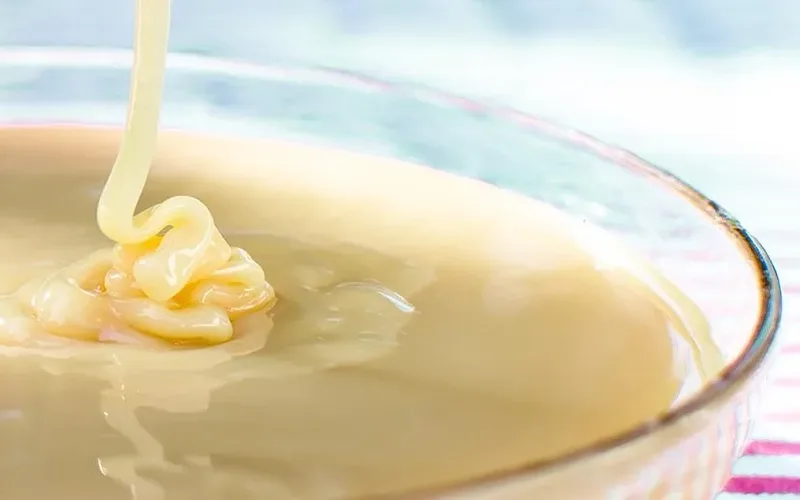
Applications
Condensed & Evaporated Milk
Forewarmers, evaporator preheaters and concentrate coolers for milk at 30 to 50 percent solids, to 5,000 cP.
+ Learn More