
1-805-484-2992
Quotes - Engineering - SalesThe hottest exchangers in a food plant
The economizer that pays for the deodorizer
Deodorization strips free fatty acids and odor compounds from oil with sparge steam at 450 to 500 F under 2 to 4 mm Hg of vacuum. Getting the oil to that temperature and back is the largest heat load in the refinery, and most of it is recovered by running deodorized oil against bleached feed in an economizer before either touches a utility.
This page covers that economizer, the final heater that takes the feed the rest of the way on thermal fluid or high-pressure steam, and the vacuum condensers that handle the fatty acid distillate and sparge steam.
Economizer, final heater and vacuum condensing
The oil-to-oil economizer
Deodorized oil at 480 F and bleached feed at 200 F, at equal mass flows, run in counterflow through a shell-and-tube economizer. With a 40 degree terminal approach the feed leaves at about 440 F and the product at about 240 F, 60 to 80 percent of the heat recovered. Oil-to-oil coefficients are 60 to 100 Btu/h-ft2-F, so the economizer is a long two- or three-shell train, and tightening the approach below 30 degrees adds surface faster than recovery.
The economizer is the exchanger that most affects oil quality as well as steam. Every minute the deodorized oil spends between 480 and 300 F in contact with air raises its peroxide value, so the economizer is nitrogen-blanketed on shutdown, the product side is polished, and the unit is fully drainable so no oil sits at temperature in a dead leg.
The final heater on thermal fluid
The economizer leaves the feed 40 to 80 degrees short of deodorizer temperature, and the final heater closes that gap. Steam at 480 F would need to be at 600 psig, which almost no food plant has, so the final heater runs on thermal fluid at 550 to 600 F in a U-tube shell-and-tube with the thermal fluid on the tube side. That keeps the higher pressure inside the tubes and means a tube leak sends oil into thermal fluid rather than thermal fluid into food.
Design pressure is set by the thermal fluid loop, and the unit is an ASME Section VIII vessel with a food-grade drainable product side rather than a 3-A exchanger.
Thermal expansion and the vacuum side
A 20 foot fixed-tubesheet bundle with 480 F oil in the tubes and 240 F oil in the shell grows over half an inch relative to the shell, and the economizer has to absorb that with a shell expansion joint or by being built as a U-tube. HeatX chooses between them on the plant's cleaning preference.
The deodorizer's sparge steam and stripped fatty acids leave the column as vapor under vacuum and are condensed in a shell-and-tube condenser on tower water, with the fatty acid distillate drained to a scrubber tank and the non-condensables vented to the vacuum system. It is sized on the sparge steam rate and the distillate load at the vacuum pressure.
The common mistake
Sizing the economizer on a tight approach to make the final heater small. The last ten degrees of approach cost more surface than the first fifty, and the final heater closes them for a fraction of the price; 40 degrees is where the curves cross on most oil trains. Send both oil flows, the deodorizer temperature, the feed temperature from the bleacher, the thermal fluid or steam conditions and the vacuum pressure. Call and talk it through with an engineer: 1-805-484-2992



Deodorizer heat recovery process conditions
The rows describe the oil and heating loops around a deodorizer, from feed economizer to final heater. Use them to check your own temperatures and thermal fluid, then include both with the quote request.
| Condition | Detail |
| Product | Bleached oil feed and deodorized oil, 2 to 5 cP at temperature; fatty acid distillate vapor |
| Flow range | 10,000 to 100,000 lb/h of oil, both streams equal |
| Temperatures in / out | Feed 180 to 220 F in, 380 to 430 F out of the economizer, 450 to 500 F out of the final heater; product 450 to 500 F in, 200 to 250 F out |
| Hold | None; residence time is in the deodorizer trays |
| Utility | Thermal fluid at 550 to 600 F, or 600 psig steam, on the final heater; tower water on the distillate condenser |
| Approach | 30 to 50 degrees terminal on the economizer; 50 to 80 degrees on thermal fluid |
| Construction | Fixed tubesheet shell-and-tube with expansion joint or U-tube; multi-pass counterflow; high-temperature gasketed plate on some economizers |
| Finish / class | 304L or 316L; ASME Section VIII; food-grade drainable; nitrogen-blanketed |
| CIP | Hot oil flush; opened on interval for polymerized oil |
Common FAQs
60 to 80 percent of the deodorizer's heating load. On a 40,000 lb/h line from 200 to 480 F that is around 4 to 5 million Btu/h the final heater no longer supplies, which on thermal fluid is most of the heater's fuel.
Reaching 480 F on steam takes 600 psig; thermal fluid does it at a few psig. The exchanger is rated for the fluid loop, the fluid runs on the tube side, and the film temperature is kept under the fluid's limit by velocity.
Either. A fixed tubesheet with a shell expansion joint keeps straight tubes that can be rodded; a U-tube bundle pulls for inspection and needs no joint. The plant's cleaning method decides.
It is a food-grade drainable ASME vessel with a polished product side, nitrogen-blanketed. Oil at 480 F with no water has no microbial risk, and 3-A geometry adds nothing at that temperature.
Related
Applications
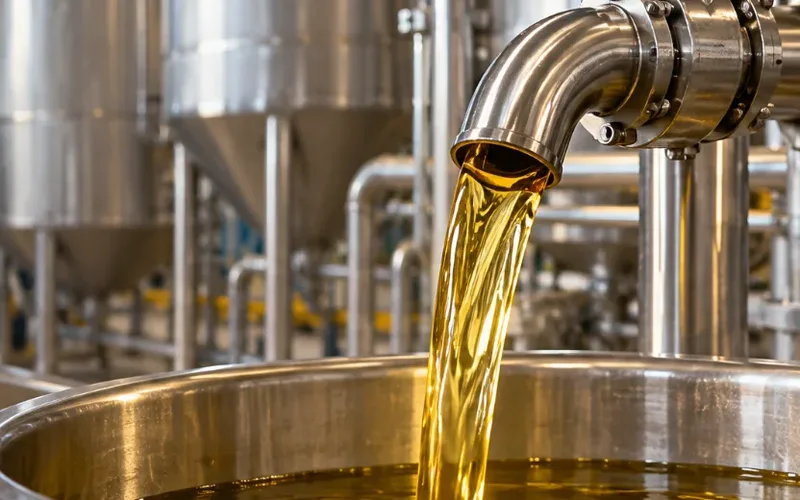
Vegetable Oil Heating & Cooling
The heaters and coolers around the refinery: degumming, neutralizing, bleaching feed and storage.
+ Learn More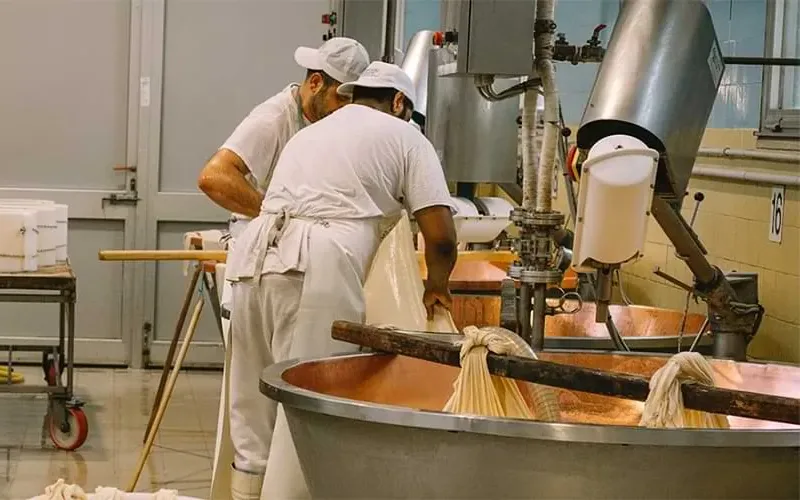
Applications
Fats, Shortening & Margarine
Solid at room temperature, kept liquid until the crystallizer and never allowed to set on a wall.
+ Learn More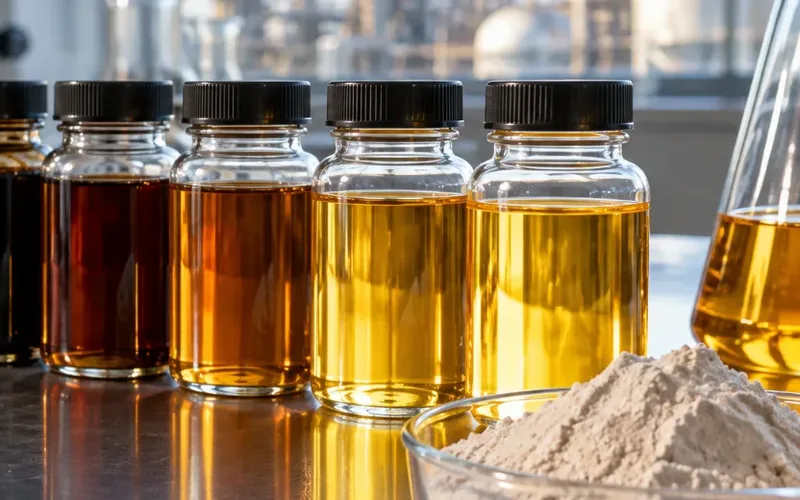
Applications
Bleaching & Winterization
The heater in front of the bleacher and the chiller in front of the wax filter, at opposite ends of the range.
+ Learn More